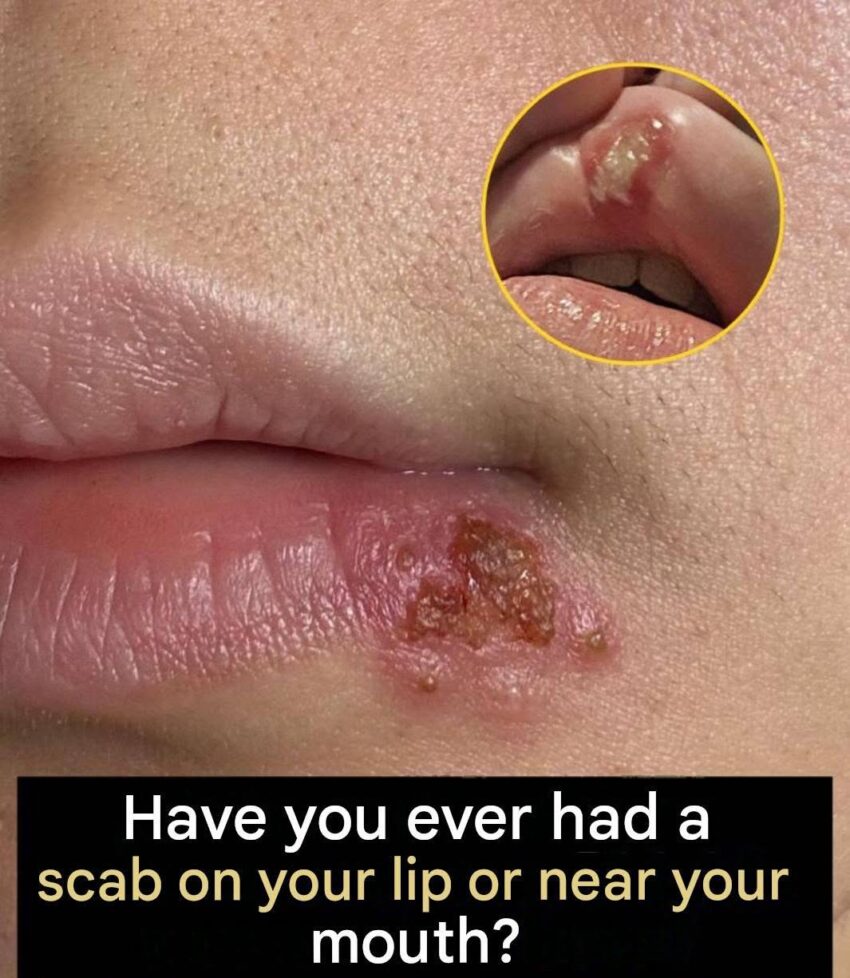
A sore or scab around the lips is common, but the appearance and how it develops can provide useful clues about what is causing it.
The image shows a crusted sore on the lip that could be consistent with a cold sore (oral herpes), particularly if it began as tingling or small fluid-filled blisters that later broke and crusted. However, a photograph alone cannot confirm the diagnosis.
The Most Common Possibility: A Cold Sore
Cold sores are usually caused by herpes simplex virus type 1 (HSV-1).
A typical outbreak often follows a recognizable sequence:
Tingling or burning → small blisters → blisters break → crust/scab → healing
Cold sores commonly occur on or around the lips and can be uncomfortable, itchy, burning, or painful. They generally heal within about 1–2 weeks.
Why do they keep coming back?
After the first infection, HSV remains in the body in an inactive state. It can reactivate later.
Possible triggers include:
- Illness or fever
- Stress
- Sun exposure
- Tiredness
- Hormonal changes
- Injury or irritation around the lips
Not everyone experiences the same triggers.
Is a Cold Sore Contagious?
Yes.
HSV can spread through contact with the sore and, in some circumstances, through saliva or skin contact even when a visible sore isn’t present.
During an active outbreak, it’s particularly important to avoid:
- Kissing
- Oral sex
- Sharing lip balm
- Sharing eating utensils
- Touching the sore and then touching another person’s skin or eyes
Wash your hands after touching the area.
Don’t pick or peel the scab. This can delay healing and potentially spread the virus to another part of your body.
What Can You Do About It?
Most uncomplicated cold sores heal without treatment.
For symptom relief:
Keep the area protected
A suitable lip balm or petroleum-based protective ointment can prevent excessive drying and cracking.
Use a cool compress
A cool, clean compress can help reduce discomfort.
Consider antiviral treatment early
Antiviral medicines can be useful for some people, particularly when started very early—during the tingling or blister stage. A pharmacist or doctor can advise whether an antiviral cream or oral medication is appropriate.
For people who experience frequent or severe outbreaks, a doctor may discuss prescription antiviral tablets.
But Not Every Lip Scab Is a Cold Sore
This is important.
A crust near the mouth could also result from:
- An ordinary cut or irritation
- Dry, cracked lips
- Impetigo, a bacterial skin infection
- Contact dermatitis
- A canker sore or other oral lesion
- Trauma from biting or picking the area
- Less commonly, another skin condition
For example, impetigo can produce characteristic honey-colored crusts, particularly around the nose and mouth, and requires different treatment.
So it isn’t advisable to assume that every crusted lip lesion is herpes.
When Should You See a Doctor?
Have the lesion evaluated if:
- It doesn’t start improving within about 1–2 weeks
- It repeatedly returns and you aren’t sure why
- It is spreading rapidly
- There is significant swelling or pus
- You develop fever or feel seriously unwell
- The sore is close to the eye
- You have a weakened immune system
- The lesion is unusually large, severe, or persistent
A sore near the eye deserves particular attention because herpes infections involving the eye can potentially affect vision.
The Bottom Line
A crusted sore on or around the lip is often a cold sore, especially when it begins with tingling followed by clusters of small blisters that break and crust.
But the picture alone isn’t enough to diagnose HSV.
If you’ve got a new sore, don’t pick it, avoid kissing or oral contact until you know what it is and it has healed, and consider getting medical or pharmacy advice early if you suspect a cold sore.
If you tell me whether the sore started as tiny blisters, whether it hurts or itches, and how many days you’ve had it, I can explain which common causes fit the pattern most closely.