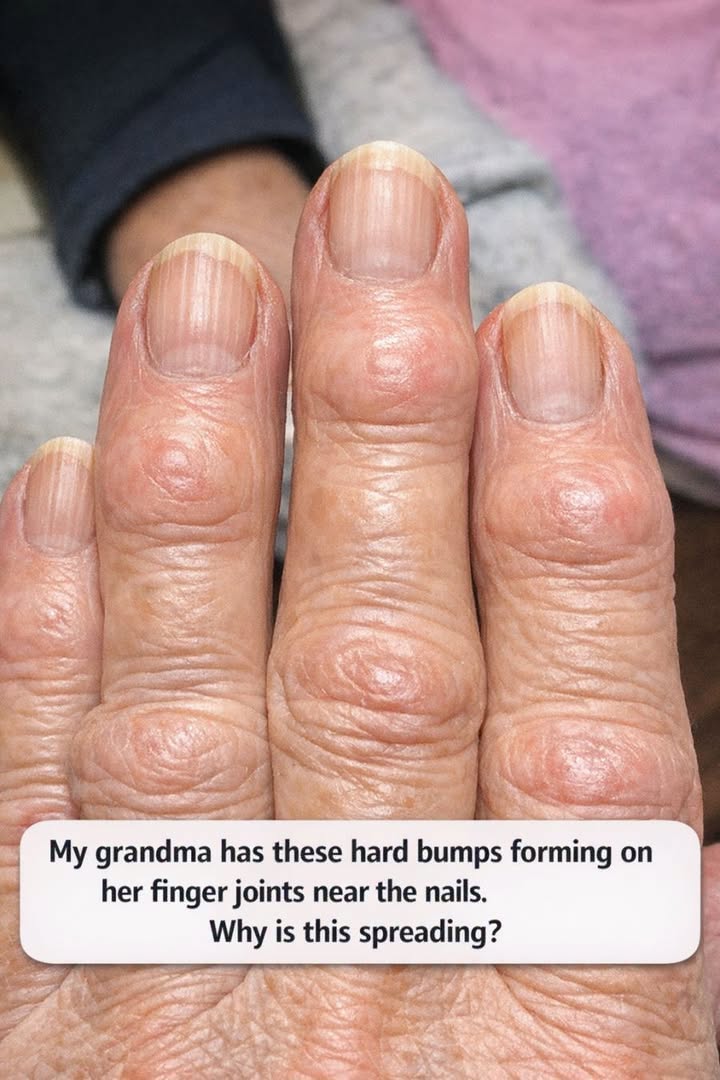
One common explanation is osteoarthritis of the finger joints, which can cause bony enlargements known as Heberden’s nodes. These bumps typically develop at the end joints of the fingers, close to the nails, and are particularly common as people get older.
But osteoarthritis isn’t the only possible cause. Here’s what you should know.
What Are Those Hard Bumps?
Heberden’s nodes are bony enlargements that develop around the distal interphalangeal (DIP) joints—the small joints nearest the fingertips.
They can feel hard rather than soft because they are related to changes in the bone and joint.
They may develop gradually and can affect several fingers, which can make it look as though the condition is “spreading.”
Why Can More Fingers Develop Them?
Osteoarthritis can affect multiple joints rather than just one.
As cartilage and other structures within a joint change over time, the body can develop new bone around the joint. This can contribute to the characteristic enlarged or knobby appearance.
Having bumps on several fingers doesn’t necessarily mean an infection is spreading from one finger to another.
Do These Bumps Hurt?
Not always.
Some people have noticeable bumps with little or no pain. Others may experience:
- Aching or tenderness
- Stiffness
- Swelling
- Reduced finger movement
- Pain when gripping or using the hands
Symptoms can also fluctuate over time.
Could It Be Something Other Than Osteoarthritis?
Yes.
Other conditions can cause swelling, lumps, or changes around the finger joints. For example, rheumatoid arthritis, gout, inflammatory arthritis, cysts, and other conditions can affect the hands.
The location of the bumps can provide clues, but appearance alone isn’t enough to determine the diagnosis.
What About Bumps Right Next to the Nail?
A bump near the end finger joint may sometimes be associated with a digital mucous (myxoid) cyst, particularly when it appears close to the nail.
These cysts can occur alongside osteoarthritis and may sometimes cause a groove or indentation in the nearby fingernail.
A healthcare professional can distinguish a cyst from a bony enlargement during an examination.
When Should She See a Doctor?
It’s worth arranging a medical evaluation if the bumps are new, progressively changing, painful, or interfering with normal hand function.
Medical attention is particularly important if there is:
- Significant redness or warmth
- Sudden severe swelling
- Severe pain
- Pus or drainage
- Fever
- Rapid changes in the finger
- Significant difficulty moving the joint
These features may point to a problem other than ordinary osteoarthritis and should be assessed.
Can These Bumps Be Prevented?
There isn’t a guaranteed way to prevent age-related osteoarthritis changes in the finger joints.
However, maintaining overall health, protecting the hands from unnecessary injury, staying physically active, and managing other medical conditions can support joint health.
Treatment depends on the underlying cause and may include pain management, exercises, splinting, occupational or physical therapy, or other treatments recommended by a healthcare professional.
The Bottom Line
Hard bumps developing around the finger joints near the nails are commonly associated with osteoarthritis, especially in older adults. When several fingers develop similar changes over time, it can reflect the fact that osteoarthritis can affect multiple joints.
However, not every bump is an arthritis node. If your grandmother’s bumps are new, changing, painful, red, warm, or accompanied by other symptoms, it’s best to have them examined rather than trying to diagnose them from appearance alone.
A simple examination by a doctor can often provide much more useful information than trying to identify the bumps from a photograph or online description.