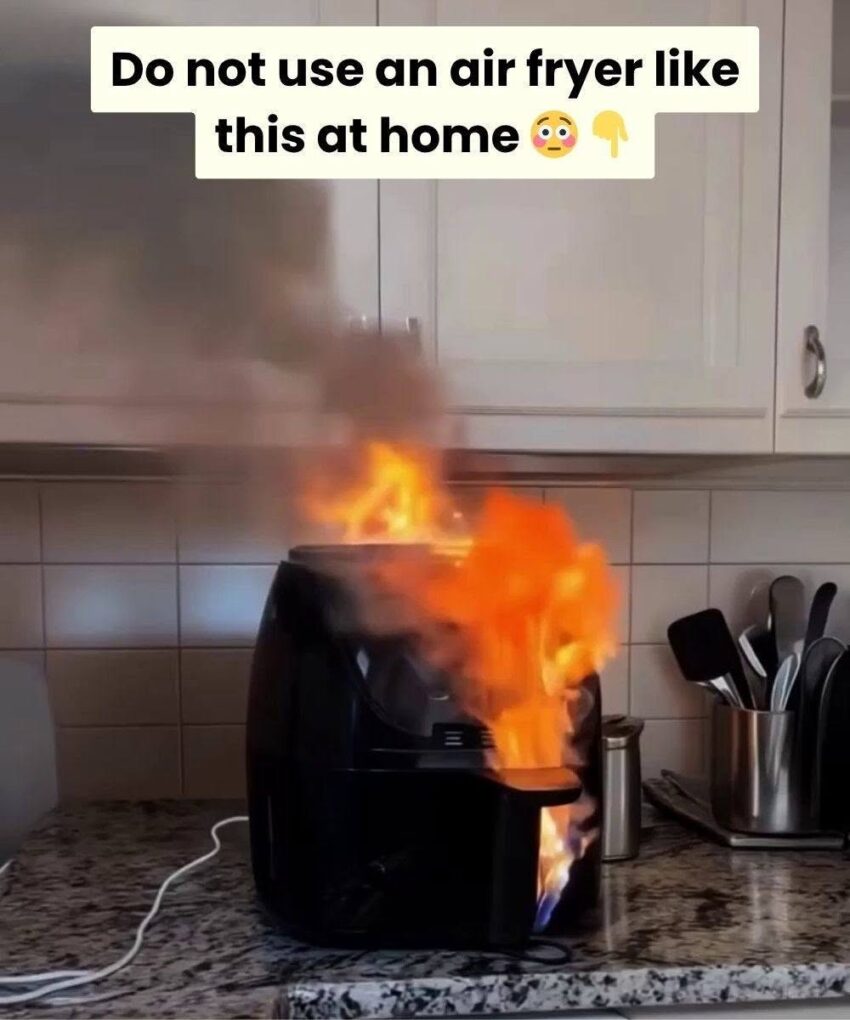
Air fryers need proper ventilation and clearance to operate safely. Learn about five indoor locations where you should avoid using an air fryer and where to place it instead.
Air fryers have become a kitchen favorite because they can cook everything from chicken and vegetables to fries and snacks with relatively little oil.
But although an air fryer is convenient, it still produces heat, steam, grease, and hot air. Where you place it can therefore matter just as much as what you’re cooking.
Many people simply put their air fryer wherever there is an available electrical outlet. That can be a mistake.
The safest approach is to place the appliance on a stable, heat-resistant, level surface with adequate clearance and ventilation, following the manufacturer’s instructions.
Here are five indoor locations where using an air fryer can create unnecessary safety risks.
1. Inside a Closed Cabinet
One of the worst places to operate an air fryer is inside a closed kitchen cabinet.
An air fryer needs to release hot air while it operates. Putting it inside an enclosed cabinet can trap heat and moisture.
This may cause excessive heat buildup around the appliance and surrounding materials.
It can also allow cooking odors, grease, and moisture to accumulate inside the cabinet.
What to do instead
Use the air fryer on an open countertop with plenty of space around it.
Once cooking is finished and the appliance has cooled completely, it can be stored away if the manufacturer’s instructions allow it.
Never operate it inside a storage cabinet simply because it fits there.
2. Directly Under Kitchen Cabinets
Even when the air fryer is technically sitting on the countertop, positioning it directly beneath overhead cabinets may not be ideal.
Many air fryers release hot air from vents near the top or back.
If that hot airflow is directed continuously toward the underside of a cabinet, it can expose the cabinet surface to heat and moisture.
Over time, repeated exposure may damage certain finishes or materials.
A better setup
Leave the clearance recommended by the manufacturer between the air fryer and nearby cabinets or walls.
If the appliance vents upward, avoid placing anything directly above it.
The instruction manual should always take priority because ventilation requirements vary between models.
3. On or Near a Stove
The area around a stove may seem like the most convenient place for an air fryer because it is already part of the cooking zone.
However, placing small appliances too close to a stovetop can create unnecessary hazards.
A nearby burner can expose the air fryer’s cord, housing, or other components to heat.
There is also a greater chance of accidentally knocking the appliance while moving pots and pans.
Keep cooking appliances separated
Place your air fryer on a stable countertop away from active burners.
Make sure the power cord cannot hang over a hot surface or come into contact with a heating element.
Keeping the cooking area organized reduces the chance of accidental contact with heat.
4. On a Wet or Unstable Surface
An air fryer should not be operated on a wet countertop or in a location where water can easily splash onto the appliance.
Electricity and water are a dangerous combination.
An unstable surface is also a problem.
If the air fryer is close to the edge of a counter or sitting on a surface that moves easily, the appliance could potentially tip or fall.
Choose a safer surface
Use a:
- Flat countertop
- Stable table
- Heat-resistant surface
- Dry area away from the sink
Make sure the appliance’s feet are sitting securely on the surface before switching it on.
5. In a Poorly Ventilated Corner
An air fryer doesn’t necessarily need to be used outdoors, but it shouldn’t be squeezed into a cramped corner with little room for airflow.
A tight space can interfere with ventilation and allow heat to accumulate around the appliance.
Steam and cooking odors can also build up more easily.
This is particularly important when cooking foods that release a lot of grease or moisture.
Give it breathing room
Position the air fryer in an open area where its ventilation openings aren’t blocked.
Don’t place objects, towels, paper, or other items against the vents.
The exact clearance required depends on the model, so check the manufacturer’s instructions.
What Should You Never Put on Top of an Air Fryer?
While the appliance is operating, don’t use its top as an extra storage shelf.
Keep away:
- Kitchen towels
- Paper
- Plastic containers
- Food packaging
- Wooden utensils
- Cleaning products
- Other appliances
The surface may become hot, and items placed too close to ventilation openings can interfere with airflow.
Be Careful With the Power Cord
The location of your air fryer should also allow the power cord to reach the outlet without creating a hazard.
Avoid:
- Running the cord across a hot stovetop
- Letting it hang where someone can pull it
- Using a damaged cord
- Placing the cord against hot surfaces
- Overloading an electrical outlet
If the plug, cord, or appliance shows signs of damage, stop using it until it has been appropriately inspected or replaced.
What About Using an Extension Cord?
This depends on the appliance and the manufacturer’s instructions.
Some manufacturers specifically advise plugging the appliance directly into a suitable wall outlet rather than using an extension cord.
Because air fryers are relatively high-powered appliances, you shouldn’t assume that any extension cord is suitable.
If your model’s instructions prohibit extension cords, follow that guidance.
Don’t Leave an Air Fryer Unattended
Even though air fryers are designed for convenient cooking, they are still heating appliances.
Avoid leaving one running while you leave the house or go to sleep.
Stay close enough to respond if something goes wrong.
If you notice unusual smoke, burning smells, sparks, or abnormal sounds, switch the appliance off and unplug it when it is safe to do so.
If a fire occurs, do not throw water onto an electrical or grease fire. Follow appropriate fire-safety procedures and call emergency services if necessary.
The Safest Place for Your Air Fryer
For most models, the safest setup is a stable, dry, heat-resistant countertop in an open, well-ventilated area, with the clearance specified by the manufacturer.
Before using the appliance, check:
- The ventilation openings are unobstructed.
- The appliance is stable.
- The power cord is away from heat.
- Nothing flammable is immediately beside or above it.
- There is adequate clearance from walls and cabinets.
- The cooking basket is properly inserted.
- The manufacturer’s instructions are being followed.
Final Takeaway
An air fryer doesn’t have to be complicated to use safely.
The biggest mistake is treating it like an ordinary storage appliance and operating it wherever there happens to be an empty space.
Avoid using it inside closed cabinets, cramped spaces, directly beneath vulnerable cabinets, near active stovetops, or on wet and unstable surfaces.
Give the appliance enough room to release heat, keep it away from water and flammable materials, and always follow the clearance and ventilation requirements in your specific model’s manual.
A few extra inches of countertop space can make a big difference when it comes to safe cooking.