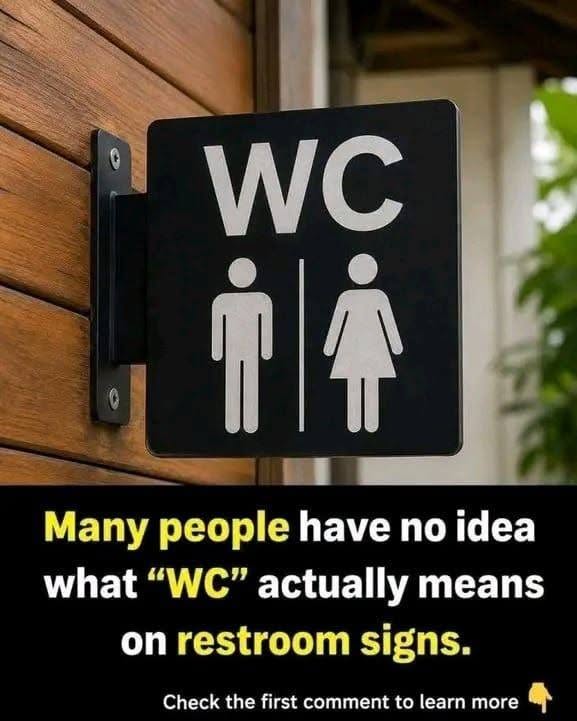
Ever wondered what “WC” means on a bathroom or toilet sign? Discover the surprisingly simple meaning behind these two letters and how the term became widely used around the world.
If you’ve ever traveled through Europe or stayed in a hotel, you’ve probably seen two letters on a bathroom door:
WC
For many people, the meaning seems obvious from the location—but what do the letters actually stand for?
Why does a toilet sometimes say “WC” instead of “Toilet,” “Bathroom,” or “Restroom”?
The answer goes back to a surprisingly straightforward piece of plumbing history.
WC Means “Water Closet”
The letters WC stand for Water Closet.
The phrase sounds unusual today, but it originally referred to a small private room containing a toilet connected to a water-flushing system.
In other words, a “water closet” was essentially a room or compartment containing a flush toilet.
The term became associated with indoor sanitation as flush toilets became more common.
Why Is It Called a “Closet”?
The word “closet” didn’t originally mean a place where you store clothes.
Historically, a closet could refer to a small private room or enclosed space.
A “water closet,” therefore, was essentially an enclosed space associated with a water-based toilet.
Over time, the expression became shortened to the familiar abbreviation:
W.C.
The History Behind the Name
The development of indoor plumbing changed everyday life dramatically.
Before modern sanitation systems became widespread, toilets were often very different from the flush toilets people use today.
Waste might be collected in containers, disposed of in outdoor facilities, or handled through other sanitation systems.
The development and spread of flush toilets created a need for a term describing this new type of indoor toilet facility.
“Water closet” became one of the terms used to describe it.
As plumbing systems improved, the phrase remained even though the technology became much more sophisticated.
Why Don’t We Usually Say “WC” in the United States?
This is where language and culture become interesting.
In the United States, people are more likely to encounter terms such as:
- Bathroom
- Restroom
- Toilet
- Lavatory
- Public restroom
“Water closet” is still understood in certain contexts, particularly in plumbing, construction, real estate, and architectural terminology, but it isn’t usually the everyday term Americans use for a public bathroom.
In many other countries, however, WC remains a familiar sign.
Where Are You Most Likely to See “WC”?
Travelers commonly encounter WC signs in parts of:
- Europe
- Asia
- Africa
- The Middle East
- International airports
- Hotels
- Train stations
- Restaurants
Because “WC” is short and relatively language-neutral, it can be useful in places where visitors speak many different languages.
A traveler who doesn’t speak the local language may still recognize the familiar abbreviation.
Is a WC the Same as a Bathroom?
Not always.
Technically, the terms can describe slightly different things.
A WC specifically refers to a toilet or toilet room.
A bathroom, depending on the country and context, may contain a toilet, sink, bathtub, shower, or some combination of these.
In everyday conversation, however, people often use the words interchangeably.
For example, someone might say:
“Where is the bathroom?”
even when they simply need to use the toilet.
The exact meaning depends heavily on regional language.
Why Does Britain Use “Loo”?
If you’ve ever watched British television, you may have heard another unusual word:
Loo.
“Loo” is an informal British term for a toilet or bathroom.
Its exact historical origin is debated, and several explanations have been proposed over the years.
Unlike “WC,” however, “loo” is a conversational word rather than a technical abbreviation.
What About “Toilet”?
The word “toilet” has an interesting history too.
Its origins are connected to French and originally related to dressing and personal grooming.
Over time, the word developed additional meanings associated with the room and fixtures used for bodily functions.
Today, “toilet” is a completely ordinary word in many English-speaking countries.
But in some places, people prefer softer or more indirect terms such as “restroom” or “bathroom.”
Why Do Hotels Often Use “WC”?
Hotels often cater to international travelers.
A sign saying WC can be immediately recognizable to visitors from many different countries.
It’s also short and easy to display on signs, maps, floor plans, and room layouts.
In architectural drawings, “WC” can also be used as a compact abbreviation for a toilet room.
WC Doesn’t Mean the Toilet Itself
One small distinction is worth remembering.
Technically, WC refers to the water closet or toilet room, rather than simply the porcelain toilet fixture itself.
In modern everyday use, though, people may use “WC” to mean the toilet or bathroom area generally.
Language often becomes less precise over time as words move from technical terminology into everyday speech.
Why Has the Term Survived?
Technology has changed dramatically since the phrase “water closet” became common.
Modern toilets have:
- Sophisticated flushing mechanisms
- Water-saving systems
- Advanced plumbing
- Different bowl designs
- Automatic features
- Bidet functions
- Heated seats in some models
Yet the abbreviation WC has survived.
That’s because signs and abbreviations can remain useful long after the original terminology becomes less common in everyday conversation.
Think of it as a linguistic fossil from the history of indoor plumbing.
Other Bathroom Abbreviations You May See
If you travel internationally, you may encounter several different terms.
WC
Water Closet
Usually refers to a toilet or toilet room.
Lav.
Short for lavatory.
It can refer to a bathroom or toilet facility, particularly in transportation and aviation.
Restroom
A common North American term for a public toilet facility.
Gents
A traditional term for a men’s toilet facility, particularly in Britain and other regions.
Ladies
A traditional term for a women’s toilet facility.
The exact terminology depends on the country and setting.
The Interesting Part About “WC”
The next time you see WC on a door, you’ll know that you’re looking at an abbreviation with a history tied directly to the development of indoor plumbing.
What now looks like a mysterious pair of letters simply means:
Water Closet.
It describes the enclosed toilet space that became associated with water-flushing sanitation.
Final Takeaway
So, what does WC actually stand for?
Water Closet.
The phrase originated as a description of a small enclosed space containing a water-flushing toilet. Although “water closet” sounds old-fashioned today, its abbreviation has survived and remains common on signs around the world.
So the next time you’re traveling and see those two letters on a door, there is no mystery left.
WC simply means you’re in the right place when nature calls.