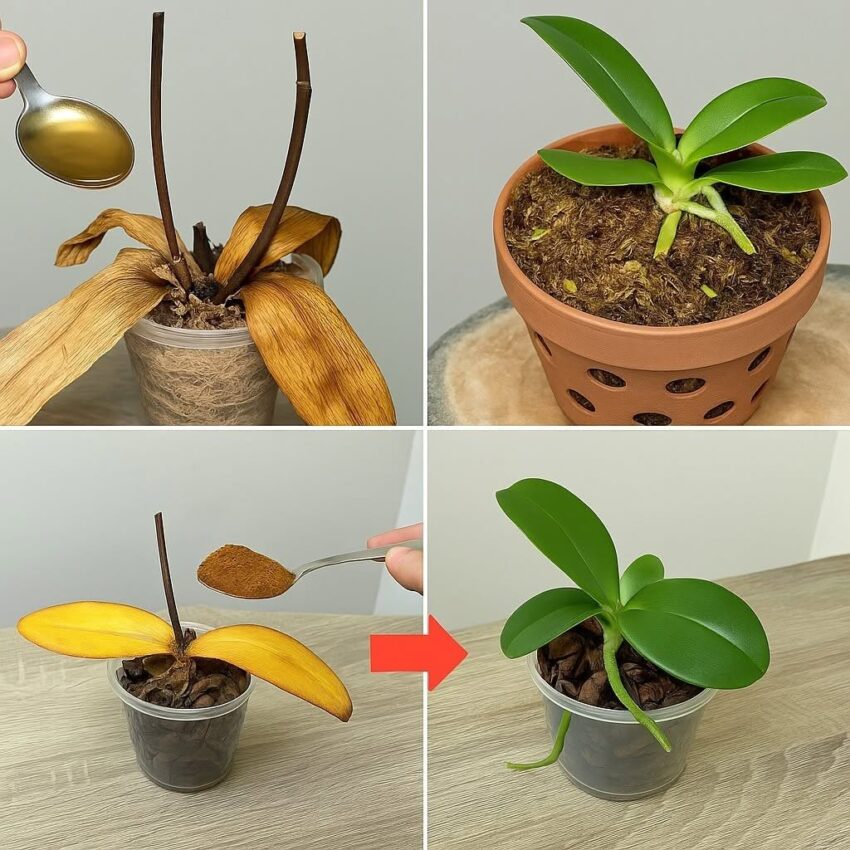
When an orchid begins losing roots, many gardeners look for a simple kitchen remedy that will bring the plant back to life. Online posts sometimes recommend sprinkling a spoonful of a household ingredient directly onto the roots.
But there is no single powder or kitchen ingredient proven to revive dead orchid roots or make an orchid bloom all year.
The good news is that an orchid with some healthy roots can often recover when its growing conditions are corrected.
First, Check Whether the Roots Are Actually Dead
Healthy orchid roots are generally firm, while dead or rotting roots may be soft, mushy, hollow, or badly discolored. The exact appearance can vary among orchid types, so color alone isn’t enough to diagnose a problem.
If the roots are mushy or hollow, excessive moisture is a common problem. The American Orchid Society recommends addressing the growing conditions and using a better-draining medium when root rot is associated with a potting medium that stays too wet.
Don’t Sprinkle Fertilizer Directly Onto Damaged Roots
More fertilizer isn’t necessarily better. Excess mineral salts can damage orchid roots and contribute to fertilizer burn. The American Orchid Society recommends using diluted fertilizer and avoiding excessive applications.
If fertilizer buildup is suspected, flushing the growing medium with plain water can help remove accumulated salts. Severely damaged orchids may need to be removed from the old medium, have dead roots trimmed, and be repotted in fresh medium.
How to Give a Struggling Orchid the Best Chance of Recovery
1. Remove dead or rotting roots
Use clean, appropriate cutting tools to remove roots that are clearly dead or decaying. Keep healthy, firm roots whenever possible.
2. Replace deteriorating potting medium
Orchid potting material breaks down over time and can hold too much moisture. Fresh, appropriate orchid medium can provide better air circulation around the roots. The American Orchid Society recommends repotting when the medium has deteriorated or when the plant has outgrown its container. (
3. Use a pot with drainage
Good drainage is essential. An orchid should not sit continuously in stagnant water.
4. Provide appropriate light
For many commonly grown orchids, insufficient light is a major reason they fail to rebloom. Bright, indirect light is generally preferable, although the ideal conditions depend on the orchid species.
5. Water appropriately
Overwatering is one of the most common causes of orchid problems. The goal isn’t simply to water more frequently—it is to provide enough moisture while allowing the growing conditions to remain appropriate for the particular orchid.
6. Fertilize carefully
Once the plant is actively recovering, a suitable orchid fertilizer can provide nutrients. Using a dilute solution is generally safer than applying concentrated fertilizer, particularly when the plant has recently suffered root damage.
Can an Orchid Really Bloom All Year?
That’s another claim worth treating cautiously.
Some orchids can flower for long periods or rebloom under favorable conditions, but no home remedy can guarantee flowers throughout the entire year. Flowering depends on the orchid’s genetics, light, temperature, watering, nutrition, and overall health.
The American Orchid Society notes that insufficient light is a common reason orchids fail to rebloom.
The Bottom Line
Don’t rely on a mysterious “one-spoon” remedy to rescue an orchid. The most effective approach is to identify why the roots are failing, remove genuinely dead roots, provide fresh well-draining medium, improve light and watering, and fertilize carefully once the plant is recovering.
A struggling orchid may take time to produce new roots and flowers, but proper care gives it a much better chance of recovery than simply adding an untested substance to the pot.
Important: If you’re planning to recommend a specific ingredient such as cinnamon, baking soda, coffee, rice, aspirin, or another household product in the headline, don’t present it as a scientifically proven orchid treatment unless you have evidence supporting that specific claim.