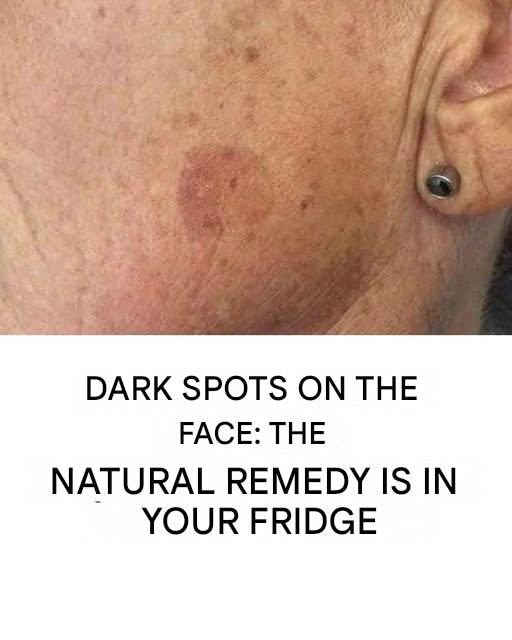
One day your skin looks clear, and the next you notice a brown mark on your cheek, forehead, or around your mouth. You may immediately start searching for a natural remedy—and your kitchen refrigerator can look surprisingly tempting.
But before rubbing lemon juice, vinegar, or other harsh ingredients onto your face, there’s something important to understand:
Not every natural ingredient is safe or effective for treating pigmentation.
Some can irritate the skin and actually make dark spots more noticeable.
So what can you safely find in your refrigerator that may support healthier-looking skin?
🥛 Plain Yogurt: A Gentle Kitchen Option
Plain, unsweetened yogurt contains lactic acid, an alpha-hydroxy acid (AHA) that can gently exfoliate the surface of the skin.
However, the concentration in ordinary yogurt isn’t standardized, so homemade yogurt masks shouldn’t be considered a medical treatment for pigmentation.
If you want to use yogurt on your face, choose plain, unsweetened yogurt, avoid broken or irritated skin, and stop immediately if you experience burning, itching, or significant redness.
For persistent pigmentation, a properly formulated skincare product is generally more predictable.
Why Do Dark Spots Appear?
“Dark spots” isn’t one single condition.
They can develop because of:
- Sun exposure
- Acne or other skin inflammation
- Picking or squeezing pimples
- Hormonal changes
- Certain medications
- Skin injuries
- Aging
- Conditions such as melasma
This is why the best treatment depends on the cause.
☀️ The Most Important Step: Protect Your Skin From the Sun
If you’re serious about reducing dark spots, there’s one habit that matters enormously:
Sun protection.
Ultraviolet exposure can darken existing pigmentation and make it harder for spots to fade.
A broad-spectrum sunscreen of SPF 30 or higher is commonly recommended. Apply it consistently to exposed skin and reapply when appropriate, particularly during prolonged outdoor activity.
Think of sunscreen as protecting your progress—not simply preventing sunburn.
🍋 Be Careful With Lemon Juice
You may have seen claims that lemon juice can naturally bleach dark spots.
It’s tempting, inexpensive, and easy to find in almost every kitchen.
But applying lemon or other acidic household ingredients directly to your skin can cause irritation. Citrus exposure followed by sunlight can also cause a skin reaction called phytophotodermatitis, which may leave additional discoloration.
So a natural ingredient isn’t necessarily a gentle ingredient.
Skip the lemon juice facial.
🥒 What About Cucumber?
Cucumber is mostly water and can feel cooling and refreshing on the skin.
It may temporarily make your skin feel hydrated and soothed, but there isn’t strong evidence that placing cucumber slices on your face will remove established dark pigmentation.
It’s fine as a refreshing skincare ritual—but don’t expect it to erase dark spots.
🥑 What You Eat Matters Too
Healthy skin isn’t created by a single ingredient.
A balanced diet containing vegetables, fruits, whole grains, protein, healthy fats, and adequate fluids supports overall health and provides nutrients needed for normal skin function.
But eating a particular food won’t selectively erase pigmentation from your face.
What Actually Helps Dark Spots?
If pigmentation is persistent, dermatologists may recommend treatments containing ingredients such as:
- Vitamin C
- Niacinamide
- Retinoids
- Azelaic acid
- Certain exfoliating acids
The right option depends on your skin type and the cause of the pigmentation.
Some treatments can cause irritation if used incorrectly, so introduce active ingredients gradually and follow product directions.
When Should You See a Dermatologist?
Don’t automatically assume every dark spot is harmless pigmentation.
A dermatologist should evaluate a spot that is new, rapidly changing, bleeding, painful, persistently itching, or noticeably different from your other spots.
Professional evaluation is also worthwhile when pigmentation keeps returning or doesn’t improve despite appropriate skincare.
The Real “Fridge Remedy”
There isn’t a magical food in your refrigerator that can make dark spots disappear overnight.
But if you want a simple natural approach, think beyond a single ingredient:
Gentle skincare + good nutrition + consistent sun protection + patience.
And if you’re dealing with stubborn pigmentation, a dermatologist can help determine exactly what you’re treating and which ingredients are most appropriate.
Final Thought
The best skincare secret isn’t always the most exotic ingredient.
Sometimes it’s simply knowing what not to put on your skin.
Before trying the latest kitchen remedy, remember: your skin is an organ, not a recipe experiment. What is safe to eat isn’t necessarily safe to apply to your face.