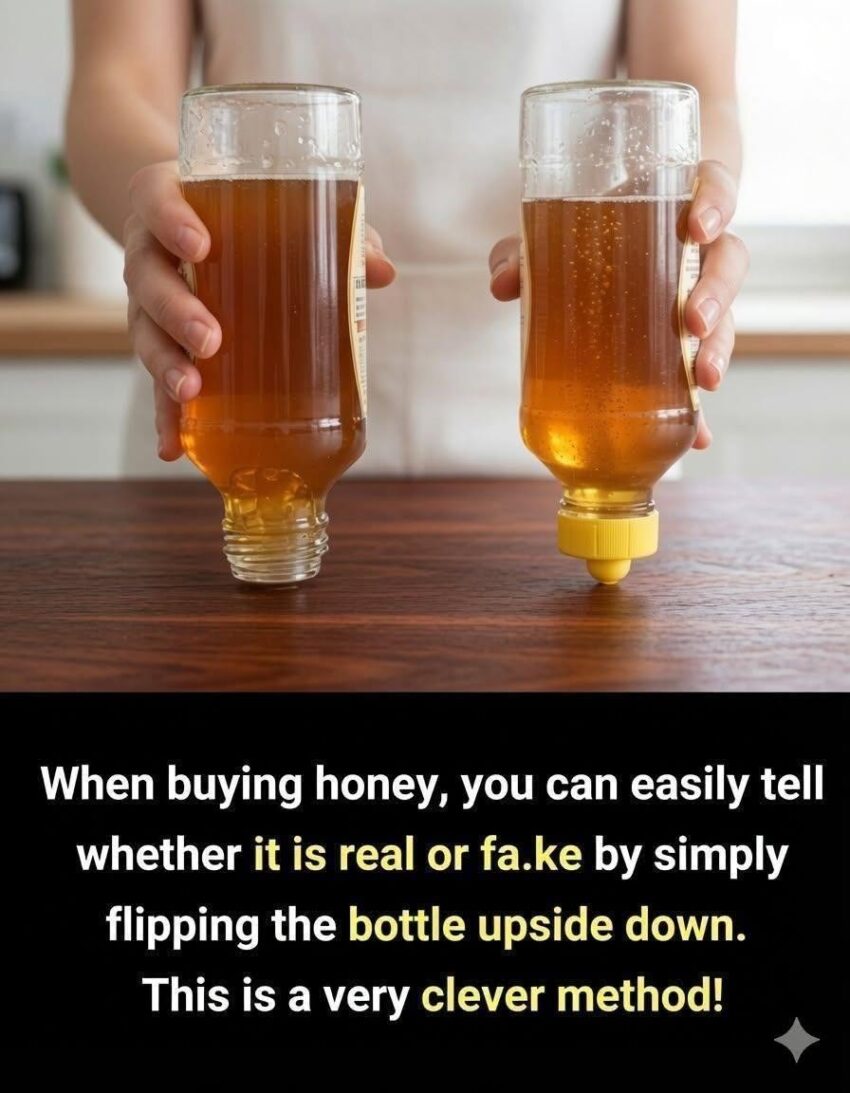
Learn how to check whether honey is real or adulterated, which popular home tests can be misleading, and what signs to look for when buying honey.
Honey has been valued for centuries for its distinctive flavor, natural sweetness, and versatility. But with honey being a relatively expensive food, concerns about adulteration are common.
Some products sold as honey may contain cheaper sweeteners or syrups made from ingredients such as cane sugar, corn, rice, or sugar beets. The FDA continues to monitor honey for this type of food fraud.
So how can you tell whether the jar sitting in your kitchen is genuine?
The answer is a little more complicated than many viral “honey tests” suggest.
First, Know What Real Honey Looks Like
Pure honey can naturally vary considerably.
Depending on the flowers visited by the bees, honey may be:
- Very light and golden
- Amber
- Dark brown
- Thick or relatively fluid
- Mildly flavored
- Strongly floral
- Clear or slightly cloudy
Because of this natural variation, color, thickness, or flavor alone cannot prove that honey is authentic.
Real honey can also crystallize.
In fact, crystallization is a natural process and does not automatically mean the honey is fake. Different types of honey crystallize at different rates, and some may remain liquid for a long time.
1. Check the Ingredient Label First
If you’re buying packaged honey, the label is one of the easiest things to examine.
Look at the ingredient list.
If a product is presented as pure honey, you generally want the ingredient list to identify honey rather than a mixture of honey and another sweetener.
The FDA explains that when other sweeteners are added, the resulting product should be labeled as a blend rather than simply “honey,” with the added ingredients properly declared.
Be especially cautious when the packaging uses vague wording such as:
- Honey-flavored syrup
- Honey blend
- Honey product
- Glucose syrup with honey
- Sweetened honey product
These aren’t necessarily dangerous, but they are not the same thing as a jar containing only honey.
2. Don’t Assume Thick Honey Is Automatically Real
One popular belief is that real honey must be extremely thick.
That’s not a reliable test.
Honey’s texture can naturally vary depending on its floral source, temperature, moisture content, and crystallization.
A thin honey isn’t automatically fake, just as an extremely thick honey isn’t automatically pure.
Temperature also matters. Honey generally becomes less viscous when warm and thicker when cool.
3. The Water Test Isn’t a Definitive Test
You’ve probably seen the viral test where you put a spoonful of honey into a glass of water.
The claim usually goes something like this:
“Real honey stays together and sinks, while fake honey immediately dissolves.”
This is not a reliable way to prove honey authenticity.
Honey’s behavior in water can be affected by its moisture content, temperature, concentration, and how it is poured.
A syrup can behave similarly to honey, while genuine honey can also disperse in water.
So if your honey dissolves quickly, don’t immediately throw it away.
The water test may be a fun kitchen experiment, but it shouldn’t be treated as a scientific authenticity test.
4. Be Careful With the Flame Test
Another popular trick involves dipping a cotton swab or matchstick into honey and attempting to light it.
The theory is that genuine honey won’t burn because it contains relatively little water, while diluted honey supposedly won’t burn.
Again, this isn’t a dependable method for identifying adulteration.
Moisture content varies naturally, and the behavior of a material around a flame can be influenced by many factors.
More importantly, deliberately testing food with an open flame creates an unnecessary fire risk.
Don’t use the flame test as your main method of checking honey.
5. The Thumb Test Isn’t Proof Either
Another common trick involves putting a drop of honey on your thumb.
People are sometimes told that:
- Real honey stays in place.
- Fake honey spreads quickly.
But viscosity alone cannot tell you whether a product contains added syrup.
Temperature and moisture can change how honey behaves.
So this test may tell you something about the honey’s consistency, but it cannot establish its purity.
6. Crystallization Doesn’t Mean Honey Is Fake
This is one of the biggest misconceptions about honey.
Many people see sugar crystals forming in a jar and assume that someone added ordinary sugar.
That’s not necessarily true.
Natural honey can crystallize because it contains different sugars, particularly glucose and fructose, in varying proportions.
Some honeys crystallize quickly, while others remain liquid much longer.
Crystallized honey can still be genuine honey.
If you prefer liquid honey, the jar can generally be gently warmed, but avoid overheating it.
7. Look at the Source
Where the honey comes from matters.
If possible, buy from a beekeeper, established producer, cooperative, or retailer that provides clear information about:
- Producer
- Country or region of origin
- Batch information
- Packaging date
- Contact information
- Ingredient information
A trustworthy source doesn’t guarantee authenticity, but transparent labeling makes it easier to trace a product if there is a problem.
8. Don’t Judge Honey by Color Alone
Dark honey isn’t automatically better.
Light honey isn’t automatically fake.
Different plants produce nectar with different characteristics, which can influence the color, aroma, flavor, and texture of the finished honey.
For example, one variety may be pale and delicate while another can be dark and intensely flavored.
Therefore, using color as a “real vs. fake” test can lead to false conclusions.
9. Taste and Smell Can Give Clues—But Not Proof
Genuine honey often has more complex aromas and flavors than simple sugar syrup.
Depending on the floral source, you may notice:
- Floral notes
- Caramel-like flavors
- Herbal aromas
- Fruity notes
- Woody or earthy characteristics
However, taste is subjective.
Someone could potentially add flavor or other ingredients to a sweetener, so tasting honey cannot scientifically prove its authenticity.
Think of taste as a clue about quality and character—not a laboratory test.
10. The Most Reliable Method Is Laboratory Testing
If you genuinely need to know whether honey has been adulterated, laboratory testing is the most dependable approach.
The FDA has used Stable Carbon Isotope Ratio Analysis (SCIRA) to investigate honey for certain undeclared sweeteners.
This type of testing examines carbon-isotope patterns in honey and its protein component. If the results are unusual, experts consider natural variation and analytical uncertainty before determining whether the sample is violative.
That’s very different from dropping honey into a glass of water.
Honey Adulteration Is a Real Food-Fraud Issue
The concern about fake honey isn’t completely made up.
The FDA’s 2025 sampling assignment tested 102 honey samples—54 domestic and 48 imported—and found four samples that were violative: two domestic and two imported. The agency reported that the samples contained undeclared sweeteners inconsistent with the products being represented as honey.
Earlier FDA sampling also found violations among some imported honey samples.
However, these samples were collected for regulatory surveillance and should not be interpreted as meaning that most honey on the market is fake. The majority of samples tested in the 2025 assignment were compliant.
A Better Way to Choose Honey
Instead of relying on one viral kitchen trick, use several practical checks together.
Before buying:
1. Read the ingredient list.
Look for a product represented clearly as honey.
2. Check the producer.
Prefer transparent sellers who provide information about where their honey comes from.
3. Examine the packaging.
Avoid containers that are damaged, leaking, improperly sealed, or unusually labeled.
4. Don’t assume crystallization means fake.
Natural honey can crystallize.
5. Don’t rely on water or flame tests.
These methods cannot reliably confirm authenticity.
6. Consider laboratory testing for certainty.
This is particularly appropriate for commercial buyers, sellers, or anyone investigating suspected adulteration.
What About “100% Pure Honey” on the Label?
A claim such as “100% pure honey” may sound reassuring, but consumers should still consider the overall labeling and source.
Food fraud can involve deliberately substituting or adding cheaper ingredients while representing the product as something more valuable.
The FDA describes this as economically motivated adulteration. Honey is one of the foods that regulators specifically monitor for this type of fraud.
Final Thoughts
There are plenty of viral tricks claiming that you can identify fake honey in seconds.
The water test, thumb test, flame test, and crystallization test may be interesting, but none of them can reliably prove that a jar of honey is pure.
The smartest approach is to look at the label, buy from a reputable and traceable source, understand that natural honey can vary in color and texture, and remember that crystallization is not evidence of fraud.
If you need certainty, laboratory analysis is the appropriate method.
So the next time someone tells you that “real honey never dissolves in water” or “fake honey always burns,” take the claim with a grain of salt.
Real honey doesn’t have one single appearance or one magical home test.