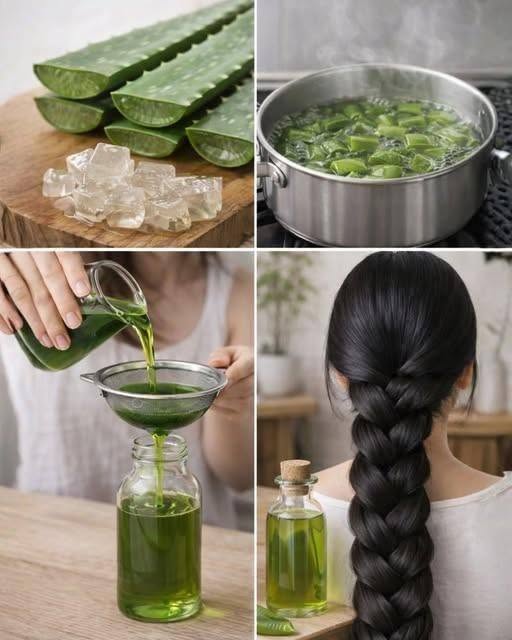
Aloe vera has long been used in traditional hair and skincare routines because its gel contains compounds that can help soothe and moisturize the skin. When combined with a carrier oil, aloe vera can make a simple scalp-and-hair treatment.
Aloe vera oil is not a proven cure for pattern hair loss, bald patches, hormonal hair loss, or other medical causes of shedding. Still, a homemade preparation can be useful as a moisturizing hair treatment when used safely.
What You Need
For a simple aloe vera oil treatment:
- 2 tablespoons fresh aloe vera gel
- 4 tablespoons coconut, olive, or jojoba oil
- A clean, dry glass container
- A small saucepan or heat-safe bowl
- A clean strainer or cheesecloth
Important note about fresh aloe
If you cut aloe directly from a plant, yellow latex can come out before the clear inner gel. This latex contains compounds that can irritate the skin and should not be deliberately incorporated into your hair preparation.
Use the clear inner gel, rinse it well, and avoid the yellow sap.
How to Make Aloe Vera Oil
Step 1: Prepare the aloe gel
Cut a fresh aloe leaf and allow the yellow sap to drain.
Wash the leaf thoroughly, remove the outer skin, and collect the clear gel inside.
Blend or mash the gel until relatively smooth.
Step 2: Combine it with your carrier oil
Add the aloe gel and carrier oil to a heat-safe container.
Warm the mixture gently using low heat.
Do not boil it.
The goal is simply to combine the ingredients gently rather than cook the aloe.
Step 3: Warm gently
Heat the mixture for several minutes while stirring occasionally.
If the mixture becomes very hot, remove it from the heat and allow it to cool.
Step 4: Strain
Once cool enough to handle, strain out remaining pieces of aloe.
Transfer the oil to a clean, dry container.
How to Use Aloe Vera Oil on Your Scalp
Apply a small amount to the scalp and gently massage with your fingertips for a few minutes.
You can leave it on for approximately 20–30 minutes before washing your hair.
If your scalp tolerates it well, some people prefer using an oil treatment before shampooing once or twice a week.
You do not need to soak your scalp in oil. More oil does not necessarily mean more hair growth.
Can Aloe Vera Actually Stop Hair Loss?
This is where expectations should remain realistic.
Hair loss has many possible causes, including:
- Androgenetic (pattern) hair loss
- Temporary shedding after illness or major stress
- Nutritional deficiencies
- Thyroid problems
- Hormonal changes
- Certain medications
- Scalp inflammation or infection
- Alopecia areata
- Tight hairstyles or repeated chemical damage
Aloe vera oil does not address all of these causes.
There is currently insufficient evidence to say that homemade aloe vera oil can stop hair loss or reliably stimulate new hair growth.
If the underlying cause is medical, treating that cause is much more important than choosing a particular hair oil.
What Aloe Vera May Actually Do
Aloe vera can provide moisture and may feel soothing on a dry or irritated scalp.
An oil-based preparation can also:
- Reduce dryness
- Make hair feel softer
- Improve lubrication
- Reduce friction during grooming
- Help protect dry hair from excessive breakage
These benefits can make hair appear healthier, but less breakage is not the same thing as increased growth from the follicle.
Hair normally grows from follicles beneath the scalp. An oil applied to the surface cannot automatically make those follicles produce hair faster.
Aloe Vera Oil vs. Aloe Vera Gel
These are not exactly the same.
Aloe vera gel is primarily water-based and may feel cooling and soothing.
Aloe vera oil combines aloe-derived material with an oil, making it more suitable as a pre-shampoo conditioning treatment.
For dry hair, the carrier oil may provide more noticeable conditioning than the aloe itself.
Try a Patch Test First
Natural ingredients can still cause irritation.
Before applying the mixture widely, put a small amount on an inconspicuous area of skin and wait to see whether irritation develops.
Stop using it if you experience:
- Burning
- Severe itching
- Redness
- Swelling
- Rash
Do not apply it to broken or infected skin.
Be Careful With Homemade Aloe Preparations
Fresh aloe contains water, which means homemade mixtures can spoil or become contaminated.
For this reason, don’t make a large batch and keep it for weeks.
A safer approach is to prepare a small amount, use clean equipment, keep it refrigerated if appropriate, and discard it if it develops an unusual smell, appearance, or texture.
Commercial products formulated with preservatives are generally more stable than homemade preparations.
What Can Actually Help With Hair Loss?
If you are experiencing persistent thinning, a better approach is to identify the cause.
For common pattern hair loss, evidence-based treatments such as topical minoxidil may help some people. Other treatments may be appropriate depending on whether the person is male or female, the pattern of hair loss, age, medical history, and other factors.
A healthcare professional or dermatologist can help determine whether you have pattern hair loss, a scalp disorder, nutritional issue, hormonal problem, or another cause.
When Hair Loss Should Be Checked
Consider medical evaluation if:
- Hair loss is sudden or severe
- You develop bald patches
- Your scalp is painful, inflamed, or very itchy
- You notice scaling or sores
- Eyebrows or eyelashes are also falling out
- Hair loss follows a new medication
- You have other unexplained symptoms
- Shedding continues for several months
- Your hairline or crown is progressively thinning
Early evaluation can be especially useful for conditions where treatment works better when started sooner.
Final Takeaway
Aloe vera oil can be a simple conditioning and scalp-care treatment, but it should not be presented as a guaranteed way to make hair grow faster or permanently stop hair loss.
If your goal is healthier-looking hair, a small amount of aloe vera combined with a suitable carrier oil may be worth trying if your scalp tolerates it. If your goal is to reverse genuine hair loss, finding the underlying cause and using a treatment supported by clinical evidence is much more important than relying on a homemade oil.