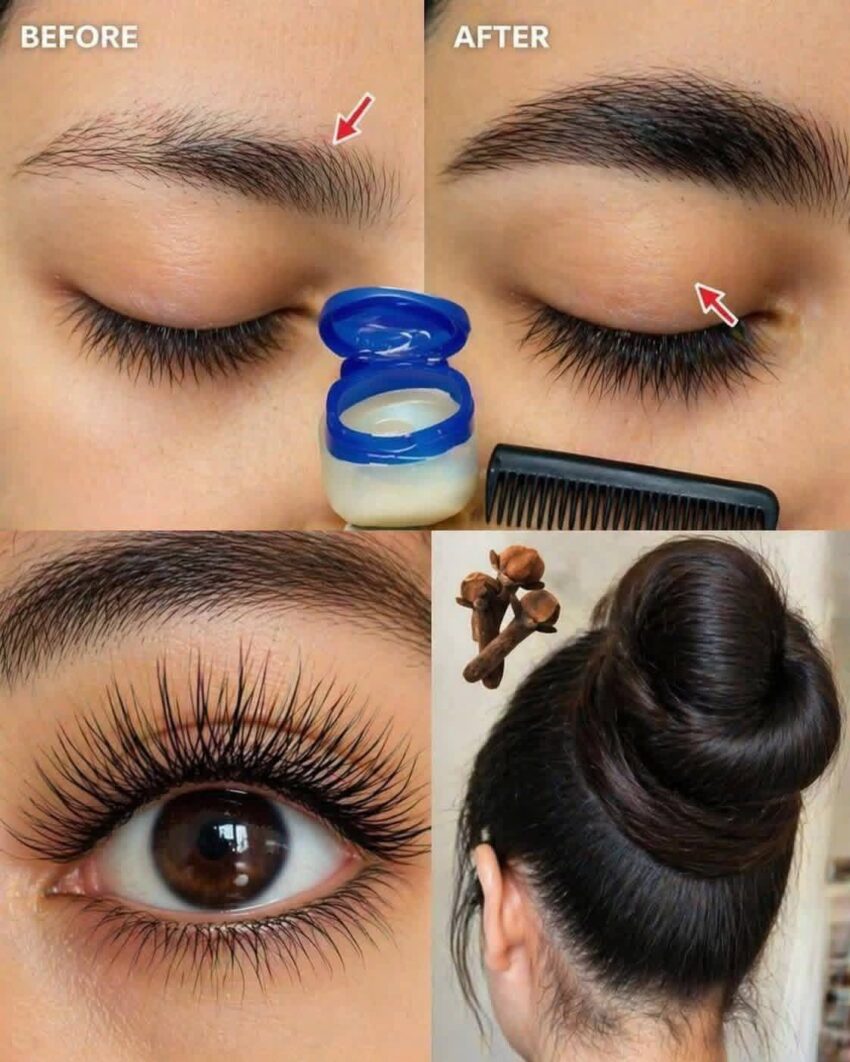
A single homemade beauty oil is often promoted online as the secret to longer eyelashes, fuller eyebrows and softer, healthier hair.
The answer is partly—but not in the miraculous way social media often suggests.
Certain plant oils can moisturize hair and reduce the feeling of dryness, while gently conditioning eyebrows and lashes. However, there is limited evidence that ordinary household oils can dramatically increase the growth rate of eyelashes, eyebrows or scalp hair.
The safest approach is to use oils primarily as conditioning treatments, not as proven hair-growth medicines.
The Simple DIY Treatment: Castor Oil
Castor oil is probably the most famous oil associated with this beauty trend.
It’s a thick vegetable oil rich in ricinoleic acid and can help coat and moisturize hair fibers, making dry hair feel softer and look shinier.
But an important distinction is often missed:
Making hair feel healthier is not the same as making new hair grow.
There isn’t strong clinical evidence that applying castor oil to eyelashes or eyebrows makes them grow dramatically longer or thicker.
How to Use It on Scalp Hair
For dry or coarse hair, castor oil can be used as a pre-shampoo conditioning treatment.
You need:
- 1 teaspoon castor oil
- 1–2 teaspoons of a lighter oil such as coconut, jojoba or olive oil
Mixing it with a lighter oil makes the thick castor oil easier to spread.
Method:
- Mix the oils in a clean container.
- Apply a small amount to the scalp or lengths of the hair.
- Massage gently with your fingertips.
- Leave it on for about 20–30 minutes.
- Wash thoroughly with shampoo.
- Condition the hair as usual.
You don’t need to soak your scalp in oil. A small amount is enough.
What About Fuller Eyebrows?
If your eyebrows are dry or brittle, a tiny amount of oil may help condition the hairs.
Use a clean spoolie or cotton swab to apply a very small amount to the brow hairs.
Keep the product away from your eyes.
Remember that eyebrow density is strongly influenced by genetics, hormones, age and whether the follicles have been damaged by repeated plucking or other causes.
Oil cannot necessarily bring back a follicle that is no longer producing hair.
And the Eyelashes?
This is where extra caution is needed.
The skin around the eyes is delicate, and putting oils directly on the eyelid or into the eye can cause irritation, blurred vision or other problems.
If you choose to use an oil near your lashes, do not put it into the eye or along the inner eyelid.
There is also no good evidence that castor oil produces dramatic eyelash growth.
For people who genuinely have sparse eyelashes, a dermatologist or eye-care professional can discuss treatments that have better evidence.
Why Does Hair Look Better After an Oil Treatment?
Oil can coat the hair shaft and reduce the rough, dry feeling of the outer surface.
This may make hair appear:
- Smoother
- Shinier
- Less frizzy
- Softer
- More manageable
That visible improvement can easily be mistaken for faster growth.
But hair growth happens inside the follicle beneath the skin. Conditioning the hair shaft doesn’t automatically make the follicle produce hair faster.
A Simple Safety Test
Before applying any new oil to your skin:
- Put a tiny amount on a small area of skin.
- Wait and watch for irritation.
- Stop if you develop redness, itching, swelling or burning.
Don’t use oils on broken or infected skin.
And never use essential oils around the eyes unless a qualified professional specifically recommends a properly formulated product.
When Hair Loss Needs More Than DIY Care
If your hair is suddenly thinning, falling out in patches or shedding much more than usual, don’t assume you simply need a better oil.
Hair loss can have many causes, including:
- Nutritional deficiencies
- Thyroid disorders
- Hormonal changes
- Stress or illness
- Certain medications
- Scalp conditions
- Pattern hair loss
- Autoimmune conditions
A dermatologist can help determine the cause and recommend treatment when appropriate.
The Bottom Line
Castor oil can be a useful conditioning oil, particularly for dry hair, but calling it a guaranteed growth treatment for lashes, brows and scalp hair is an exaggeration.
For softer hair, use a small amount as a pre-shampoo treatment.
For eyebrows, use only a tiny amount and keep it away from the eyes.
For eyelashes, be especially cautious—the eye area isn’t the place for aggressive DIY experiments.
The real secret to fuller-looking hair is understanding the difference between conditioning existing hair and actually stimulating new growth.