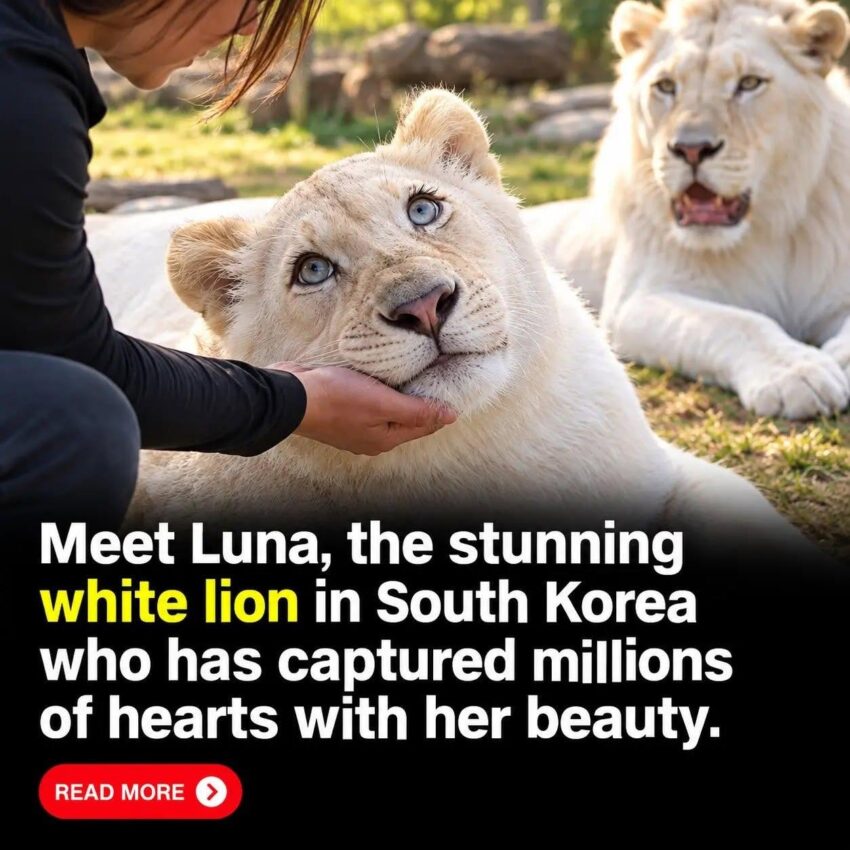
Meet Luna, the stunning white lioness whose pale coat and striking appearance have captured people’s imagination. Discover the fascinating science behind white lions, their genetics, and what makes these rare big cats so extraordinary.
Meet Luna: The White Lioness Who Looks Almost Magical
Imagine seeing a lioness with a coat as pale as freshly fallen snow, soft cream-colored fur, and eyes that seem to shine against her nearly white face. At first glance, such an animal might look like something from a fantasy film. Yet white lions are real, and their extraordinary appearance has fascinated wildlife enthusiasts around the world.
Luna is described in the title of this story as a magnificent white lioness from South Korea. Her name evokes the moon, making it a fitting choice for an animal whose pale coloring can look almost otherworldly.
However, without a verified source confirming Luna’s identity and location, her individual story cannot be independently established. What is well documented is the existence of white lions and the remarkable genetic trait responsible for their unusual appearance.
What Makes White Lions So Special?
White lions are not a separate species. They are African lions (Panthera leo) with a rare inherited trait that reduces pigmentation in their fur.
Unlike true albino animals, white lions generally retain pigment in their eyes and skin. Their coats are usually white, ivory, or pale cream rather than the orange-gold coloring most people associate with lions.
Their appearance results from a condition known as leucism, which affects pigmentation. White lions are commonly associated with a recessive genetic variant involving the TYR gene, which plays an important role in melanin production.
For a cub to inherit the characteristic white coat, it generally needs to receive the relevant variant from both parents. Two normally colored lions can therefore produce white cubs if both carry the variant.
Are White Lions Really That Rare?
White lions are uncommon in the wild, and their unusual coloring has made them highly sought after by wildlife enthusiasts.
They are historically associated with the Timbavati region of South Africa, where white lions were documented in the twentieth century. Today, white lions can also be found in managed wildlife facilities and captive breeding environments in different parts of the world.
Their rarity can make them vulnerable to exploitation, particularly when people prioritize their unusual appearance over their welfare.
It is important to distinguish naturally occurring white lions from animals selectively bred in captivity to produce the same distinctive coat.
Do White Lions Have Magical Powers?
Their appearance may seem magical, but white lions have no known supernatural abilities. Their distinctive coloring is explained by genetics rather than anything mystical.
Like other African lions, they are powerful predators with strong muscles, sharp teeth, and excellent senses. They depend on their physical abilities, experience, and natural behaviors to survive.
Their pale coats may also make camouflage more difficult in some environments, particularly where vegetation and dry grass provide the golden-brown coloring typical lions blend into.
White lions still require the same food, veterinary care, suitable habitat, and opportunities to express natural behaviors as other lions.
What Is Life Like for a White Lioness?
A female lion plays an important role in the social structure of a lion group, often called a pride. Lionesses may cooperate in hunting, caring for cubs, and defending their territory.
Their hunting strategies depend on factors such as prey availability, habitat, group size, and experience. Although lionesses frequently cooperate when hunting, they do not necessarily hunt together on every occasion.
A white lioness has broadly the same biological needs as other lionesses. Her pale coat does not make her a different species, nor does it automatically indicate that she is healthier, weaker, or more gentle.
If Luna lives in a zoo or sanctuary, the quality of her care would depend on the facility’s standards, enclosure design, veterinary support, nutrition, and enrichment—not simply on her striking appearance.
Why Do People Find White Lions So Beautiful?
White lions stand out because their coloring contrasts dramatically with the familiar golden coat of an African lion.
Their ivory fur, pale facial markings, and powerful build create an appearance that many people describe as elegant or dreamlike. Photographs can make this effect even more striking, especially when soft lighting emphasizes the coat.
However, photographs alone do not establish an animal’s identity, location, health, or living conditions. Images shared online may also be edited, mislabeled, or separated from their original context.
For anyone curious about Luna specifically, a reliable zoo, sanctuary, conservation organization, or original photographer would be the best source for confirming her story.
Why Protecting White Lions Matters
White lions are part of the broader conservation story of African lions, whose populations face pressures including habitat loss, conflict with people, and declines in natural prey in some areas.
Protecting lions requires preserving suitable habitats, reducing conflict between communities and wildlife, supporting responsible conservation programs, and discouraging illegal wildlife trade.
The unusual appearance of white lions should not distract from their needs as living animals. Responsible wildlife facilities prioritize animal welfare and conservation education rather than treating rare animals as attractions alone.
Final Thoughts
A white lioness like the one described as Luna can inspire wonder because her appearance seems almost too extraordinary to be real. Yet white lions are genuine animals whose unusual coloring has a fascinating genetic explanation.
Although Luna’s specific identity and connection to South Korea would need reliable confirmation, the science and beauty of white lions are remarkable in their own right.
Their pale coats remind us of the incredible variation found in nature—and of the importance of protecting the animals and habitats that make our world so extraordinary.
Nature does not need magic to be astonishing. Sometimes, the truth behind an extraordinary animal is just as fascinating as the legend surrounding it.