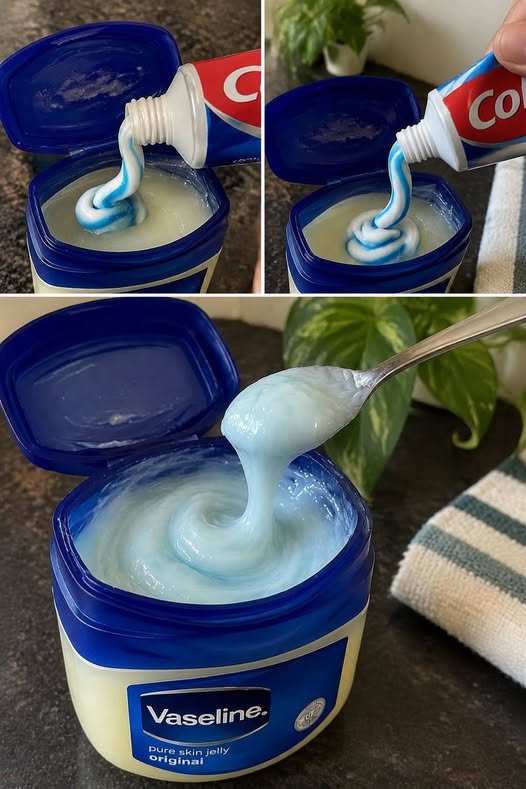
Mixing toothpaste and Vaseline is a popular home-remedy trick, but does it really work? Learn what this combination may do, what it cannot do, and safer ways to care for dry or rough skin.
There are countless home remedies circulating online that promise surprisingly quick results using products already sitting in your bathroom cabinet. One combination that frequently attracts attention is toothpaste mixed with Vaseline.
At first, it sounds unusual. Toothpaste is designed for cleaning teeth, while Vaseline is commonly used to protect and moisturize the skin. So why would anyone combine the two?
Some people claim that the mixture can help with rough-looking skin, minor blemishes, dark areas, or other cosmetic concerns. But before trying an internet remedy simply because it appears to work in a video, it is important to understand what these products actually do—and where the risks may be.
Why Do People Mix Toothpaste With Vaseline?
The idea behind this DIY mixture usually comes from combining two very different products.
Vaseline, which contains petrolatum, forms a protective layer over the skin. This helps reduce moisture loss and can make dry or rough skin feel softer.
Toothpaste, on the other hand, is formulated for the mouth rather than the skin. Many toothpastes contain ingredients such as fluoride, detergents, flavoring agents, abrasives, and other compounds designed for dental cleaning.
Because toothpaste can create a cooling, tingling, or tightening sensation, some people interpret that feeling as evidence that it is treating a skin problem. However, a noticeable sensation does not necessarily mean that the skin is benefiting.
What Can Vaseline Actually Do for Your Skin?
Vaseline has a much clearer role in skincare.
Petrolatum works primarily as an occlusive moisturizer. Instead of adding large amounts of water to the skin, it helps reduce water loss by forming a protective barrier.
This can be particularly useful for:
- Dry hands
- Rough elbows and knees
- Dry heels
- Chapped areas
- Mildly irritated skin
- Areas that become dry because of frequent washing
For very dry skin, applying a thin layer of plain petroleum jelly to slightly damp skin can be a simple and inexpensive option.
What About Toothpaste?
This is where you should be more careful.
Toothpaste isn’t designed to be a facial treatment. Some formulas contain ingredients that can irritate sensitive skin, especially around the lips, nose, eyes, and other delicate areas.
Possible reactions include:
- Burning or stinging
- Redness
- Dryness
- Peeling
- Itching
- Irritation
- Worsening of an existing skin problem
People with sensitive or eczema-prone skin may be particularly likely to experience irritation.
Can Toothpaste and Vaseline Remove Dark Spots?
This is one of the most common claims associated with DIY toothpaste remedies, but there is no good reason to expect the mixture to safely remove pigmentation.
Dark spots can have many causes, including acne marks, sun exposure, hormonal changes, friction, and inflammation. Treating the underlying cause is generally more useful than applying an irritating household product.
In fact, irritating the skin can sometimes make pigmentation appear darker, particularly in people whose skin develops post-inflammatory hyperpigmentation easily.
So if the goal is to lighten dark areas, toothpaste is not a reliable solution.
Can the Mixture Treat Pimples?
Another popular claim is that toothpaste can dry out pimples.
Although toothpaste may make a spot feel dry, this does not mean it is an appropriate acne treatment. Irritation can make a blemish look redder and may damage the skin barrier around it.
For occasional pimples, products specifically formulated for acne are a much more sensible choice.
Common evidence-based acne ingredients include benzoyl peroxide and salicylic acid, although the appropriate choice depends on your skin and the type of acne.
Why Does the Mixture Sometimes Appear to Work?
There is an important reason DIY remedies can seem convincing.
When toothpaste is applied to the skin, it can temporarily change how the surface looks or feels. The area may become dry or tight, while Vaseline can make the surrounding skin appear smoother.
That temporary cosmetic change can be mistaken for a treatment effect.
But temporary improvement in appearance is not necessarily the same as repairing the skin or treating the underlying problem.
This is why before-and-after videos should be viewed cautiously.
A Safer Way to Use Vaseline
If your actual concern is dry, rough, or flaky skin, you don’t need toothpaste at all.
Try this simple routine:
Step 1: Clean the Area
Wash the skin gently with lukewarm water and a mild cleanser if necessary.
Step 2: Leave the Skin Slightly Damp
Don’t completely dry the area if you’re dealing with dryness.
Step 3: Apply a Thin Layer of Vaseline
Use a small amount and spread it gently over the dry area.
Step 4: Repeat as Needed
For very dry areas such as heels, hands, or elbows, using petroleum jelly regularly can help maintain the skin barrier.
What If You Still Want to Try the Mixture?
Because toothpaste is not formulated for skincare, the safest approach is not to use the mixture on your face or other sensitive areas.
If you have already applied toothpaste to your skin and experience burning, significant redness, swelling, or persistent irritation, wash it off gently and stop using it.
Avoid applying additional irritating ingredients to the area while the skin recovers.
Better Alternatives for Common Skin Concerns
Instead of using toothpaste, choose a product according to the problem you’re trying to solve.
For dryness:
Use a fragrance-free moisturizer or plain petroleum jelly.
For rough heels:
Use a moisturizer containing ingredients such as urea, followed by petroleum jelly if additional protection is needed.
For acne:
Consider properly formulated acne products rather than toothpaste.
For dark spots:
Daily sunscreen and suitable pigmentation-focused skincare are generally more appropriate.
For irritated skin:
Keep the routine simple and avoid unnecessary active ingredients until the skin settles.
The Bottom Line
The combination of toothpaste and Vaseline may sound like a clever beauty hack, but there is no strong evidence that mixing them creates a special skincare treatment.
Vaseline itself can be extremely useful for protecting and moisturizing dry skin. Toothpaste, however, belongs on your teeth—not as a general-purpose facial treatment.
If a skincare remedy causes burning or irritation, that sensation should not be interpreted as proof that it is working.
Sometimes the simplest approach is also the safest: use Vaseline for what Vaseline is designed to do, and choose skincare products that are actually formulated for the skin.
Before trying any viral DIY remedy, especially on the face, it’s worth asking one simple question: Is this product actually intended to be used on skin?