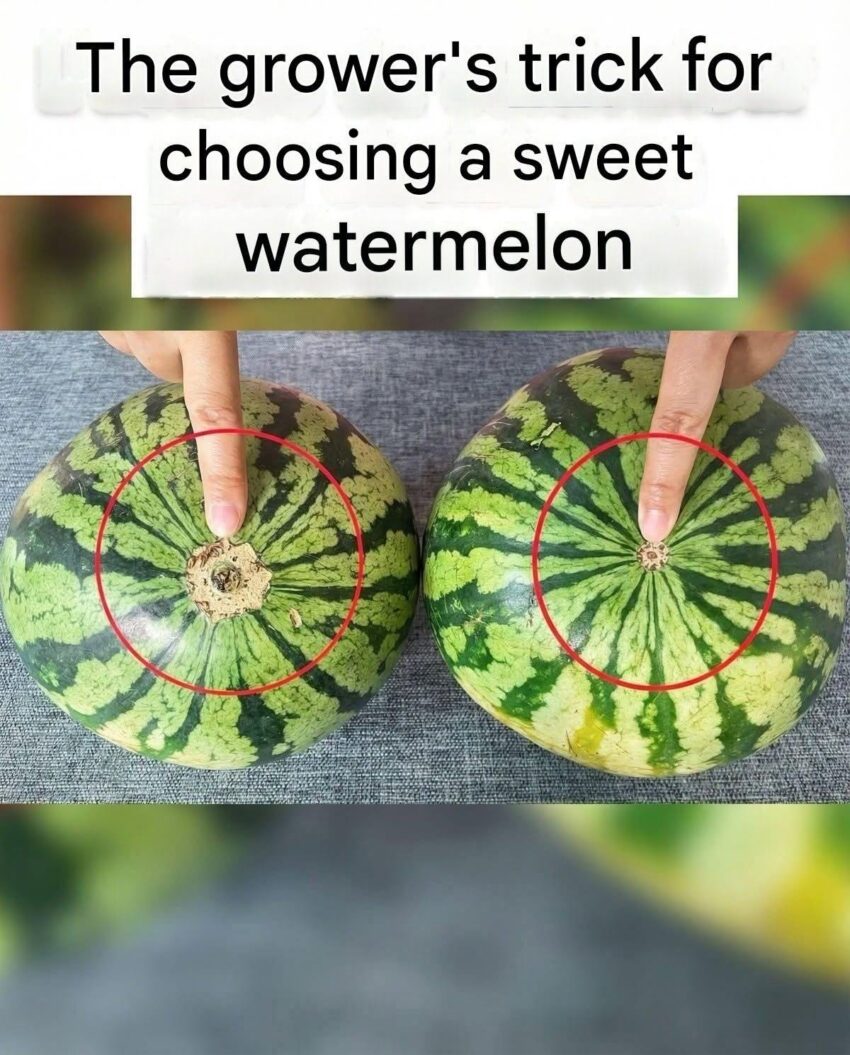
Tired of cutting into bland watermelon? Learn the simple visual clues shoppers can check at the market to improve their chances of choosing a sweet, ripe melon.
No More Bland Watermelons! Here’s the Visual Detail to Check to Bring Home the Sweetest Fruit
There is something especially disappointing about choosing a beautiful watermelon, carrying it home, cutting it open—and discovering that it is pale, watery, or almost flavorless.
The good news is that you don’t have to choose a watermelon completely at random.
While no outside feature can guarantee sweetness with absolute certainty, several visual clues can help you make a much better choice at the market.
And one of the easiest clues to spot is hiding on the side of the watermelon.
Look for the Yellow Field Spot
Turn the watermelon over and look for the large discolored patch where it rested on the ground while growing.
This is commonly called the field spot.
Instead of looking for a watermelon that is perfectly green all over, look for one with a creamy yellow to yellow-orange field spot.
A pale white or very light-green spot can be a less useful sign, while a deeper creamy-yellow patch often indicates that the watermelon spent substantial time resting in the field as it matured.
The important thing is that you’re looking for a natural-looking patch rather than a perfectly uniform exterior.
Why Is the Yellow Spot Important?
Watermelons don’t ripen in exactly the same way as fruits such as bananas or peaches after they’re picked.
Because of that, choosing a good melon at the market is largely about identifying signs associated with maturity and growing conditions.
The field spot can provide a visual clue about how the melon developed while resting on the ground.
A watermelon with a noticeable creamy-yellow patch may therefore be a better candidate than one with a barely visible white patch.
But remember: it’s a clue, not a guarantee.
Different varieties can have different appearances, and growing, harvesting, storage, and handling conditions can all affect the final quality.
Don’t Choose the Greenest Watermelon
A common mistake is assuming that the brightest, most vivid green watermelon must be the freshest or sweetest.
Color alone doesn’t tell the whole story.
Instead, examine the entire fruit.
A good watermelon should generally have a healthy-looking rind without extensive soft spots, deep cracks, bruises, or signs of decay.
If you’re comparing several melons, don’t simply grab the one with the darkest green skin.
Turn them over and compare their field spots.
Check the Shape
Shape can also help you narrow down your choices.
Look for a watermelon that appears symmetrical and evenly developed.
Some melons are naturally round, while others are more oval or elongated depending on the variety.
The exact shape isn’t as important as consistency.
Avoid fruits with unusually irregular bumps, major indentations, or obvious areas that look damaged.
An odd shape doesn’t automatically mean a watermelon is bad, but if you’re choosing between otherwise similar melons, a well-developed, symmetrical one can be a reasonable choice.
Give It a Gentle Tap
You’ve probably seen people knocking on watermelons at the market.
There is a reason this tradition exists, although the technique isn’t as reliable as many internet claims suggest.
Some shoppers look for a watermelon that produces a relatively deep, solid sound when gently tapped.
A very dull or flat sound may indicate a different texture or condition inside, but sound alone isn’t a dependable sweetness test.
Think of tapping as one additional clue—not the deciding factor.
Compare the Weight
Here’s another simple trick that doesn’t require any special knowledge.
Pick up two watermelons that are approximately the same size.
The heavier one may contain more water relative to its size, which can be a useful sign when selecting between similar fruits.
You’re essentially looking for a watermelon that feels heavy for its size.
Of course, this doesn’t tell you exactly how sweet it will taste.
It simply gives you another piece of information to combine with the visual clues.
What About the Brown Webbing?
You may sometimes notice brown, web-like markings on the rind.
These markings can attract attention because shoppers often associate them with sweetness.
However, they aren’t a guaranteed indicator that the inside will be exceptionally sweet.
Don’t reject a watermelon simply because it doesn’t have dramatic webbing, and don’t buy one solely because it does.
The field spot, overall condition, weight, and appearance are more useful when considered together.
Avoid These Warning Signs
Even if a watermelon has a beautiful yellow field spot, you should inspect it for obvious problems before buying it.
Be cautious with melons showing:
- Large soft or sunken areas
- Deep cracks
- Significant bruising
- Mold
- Leaking liquid
- Strong unpleasant odors
- Severely damaged or broken skin
A small superficial mark isn’t necessarily a problem. Watermelons can get minor scratches during harvesting and transportation.
The bigger concern is damage that appears deep, wet, soft, or deteriorated.
The Simple Market Checklist
Next time you’re standing in front of a pile of watermelons, don’t overcomplicate the decision.
Use this quick checklist:
1. Turn it over.
Look for a creamy yellow field spot.
2. Check the shape.
Choose a well-developed melon without major deformities or damage.
3. Compare the weight.
When two melons are similar in size, see which feels heavier.
4. Inspect the rind.
Avoid obvious soft spots, mold, leaking, or serious cracks.
5. Use tapping only as an extra clue.
Don’t rely on sound alone.
Is the Yellow Spot a Guarantee of Sweetness?
No.
This is important because watermelon-shopping advice is often presented as if one secret trick can reveal exactly how sweet the fruit will be.
It can’t.
Sweetness is influenced by the watermelon variety, growing conditions, maturity at harvest, and other factors.
The yellow field spot is simply one of the more practical visual clues shoppers can use.
Combining several clues is much more sensible than depending on one supposed “secret.”
What to Do Once You Bring It Home
Once you’ve selected your watermelon, store it appropriately.
If it is whole and you’re not cutting it immediately, keep it in a suitable clean area according to your kitchen’s temperature and food-safety practices.
Once you cut it, refrigerate the pieces promptly in a clean, covered container.
And always use clean hands, knives, cutting boards, and preparation surfaces when cutting fresh produce.
The Bottom Line
The next time you shop for watermelon, don’t judge it by its bright green exterior alone.
Turn it over and look at the field spot.
A creamy yellow patch can be a useful sign that the melon had time to develop in the field. Combine that clue with good weight, a healthy rind, and an even shape, and you’ll have a better strategy than simply picking the prettiest watermelon in the pile.
There may not be a truly foolproof way to predict sweetness without cutting the fruit open, but these simple checks can certainly make your next watermelon-shopping trip more informed.