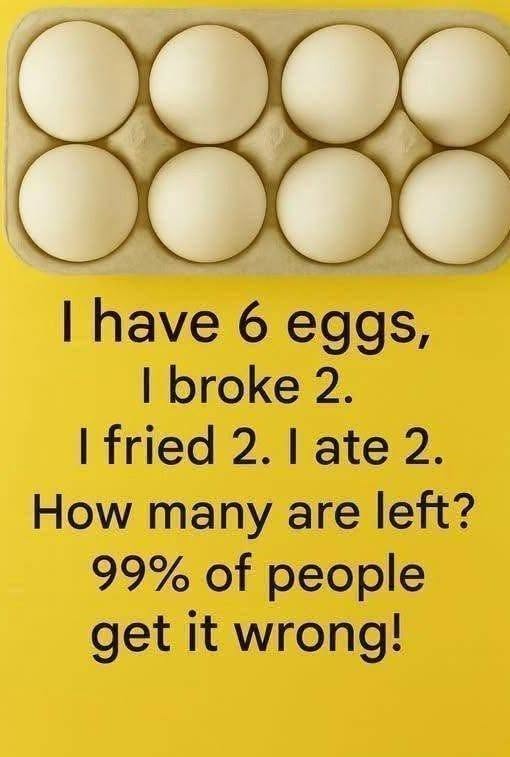
Think you can solve the famous 6-egg riddle? Discover the simple but clever answer and why so many people get this brain teaser wrong.
Sometimes the simplest questions are the ones that make us think the hardest.
One viral brain teaser involving six eggs has confused countless people because it looks like a straightforward subtraction problem. At first, many people immediately start adding the numbers in the sentence. But there is a small detail in the wording that changes everything.
Here is the riddle:
“I have 6 eggs. I broke 2, fried 2, and ate 2. How many eggs are left?”
What would your answer be?
0? 2? 4?
If you answered 4, you caught the trick.
The Answer Is 4 Eggs
Let’s slow down and look at what actually happened.
You start with:
6 eggs
Then:
I broke 2 eggs.
Now you have 2 broken eggs and 4 eggs that are still whole.
Next:
I fried 2 eggs.
The riddle doesn’t say that you fried two different eggs.
The most natural interpretation is that you fried the same two eggs you had just broken.
Finally:
I ate 2 eggs.
Again, those can be the same two eggs that were broken and fried.
So the entire sequence involves just two eggs.
6 − 2 = 4
That means:
4 eggs are left.
The same two eggs were:
- Broken
- Fried
- Eaten
They weren’t three separate groups of two eggs.
Why Do People Answer 0?
This is where the riddle gets clever.
When people read:
- Broke 2
- Fried 2
- Ate 2
they may instinctively calculate:
2 + 2 + 2 = 6
Then:
6 − 6 = 0
But that calculation assumes that six different eggs were involved.
The wording never says that.
It doesn’t say:
“I broke 2 different eggs, fried 2 other eggs, and ate 2 more eggs.”
Instead, the actions can all describe what happened to the same two eggs.
That’s the trick.
Think About It Like Cooking
Imagine someone says:
“I took two potatoes, peeled two, cooked two, and ate two.”
You wouldn’t normally assume they used six potatoes.
The same two potatoes could have been peeled, cooked, and eaten.
The egg riddle works the same way.
The sequence describes different actions performed on the same objects, rather than separate objects being used for every action.
Why This Riddle Is So Effective
The puzzle isn’t really testing your ability to subtract.
It’s testing whether you carefully examine the language.
Our brains often try to solve simple problems as quickly as possible. When we see three numbers—2, 2, and 2—we automatically want to combine them.
That’s exactly what makes the riddle effective.
The puzzle encourages you to make an assumption that the wording never actually gives you.
The Step-by-Step Solution
Here’s the entire puzzle in a simple table:
| Action | Eggs involved |
|---|---|
| Starting amount | 6 |
| Eggs broken | 2 |
| Eggs fried | The same 2 |
| Eggs eaten | The same 2 |
| Eggs remaining | 4 |
So although the number 2 appears three times, it doesn’t mean six eggs were used.
It means the same two eggs went through three different stages.
Could Someone Argue That the Answer Is Different?
Yes—and that’s what makes the riddle interesting.
Strictly speaking, the wording is somewhat ambiguous because it doesn’t explicitly state that the same two eggs were broken, fried, and eaten.
However, the conventional answer to this viral version is 4 eggs, because the simplest interpretation is that the two eggs mentioned in each action are the same two eggs. Multiple versions of the riddle circulating online give 4 as the intended answer.
If the riddle specifically said that six different eggs were involved, then the answer would obviously be different.
But it doesn’t.
The Real Lesson Behind the Riddle
There is a surprisingly useful lesson hidden inside this little puzzle:
Don’t assume information that isn’t actually stated.
This applies far beyond riddles.
When reading instructions, contracts, recipes, news stories, or even social-media posts, it’s easy to fill in missing information automatically.
Sometimes our assumption is correct.
Sometimes it isn’t.
A good habit is to ask:
“What does the information actually say?”
rather than:
“What do I expect it to mean?”
Can You Trick Someone Else With It?
Absolutely.
Ask someone quickly:
“I have six eggs. I broke two, fried two, and ate two. How many are left?”
Don’t give them time to overthink it.
Many people will immediately say zero.
Then explain that the same two eggs were broken, fried, and eaten.
Suddenly the answer seems obvious.
That’s what makes this kind of brain teaser so satisfying: once you know the trick, you wonder how you missed it the first time.
Final Answer
If you start with six eggs and the same two eggs are broken, fried, and eaten, then:
6 − 2 = 4
🥚 Final answer: 4 eggs are left.
The trick isn’t complicated mathematics. It’s simply paying attention to the wording and recognizing that one object can be involved in several different actions.
So, did you get 4 on your first try—or did the riddle fool you?