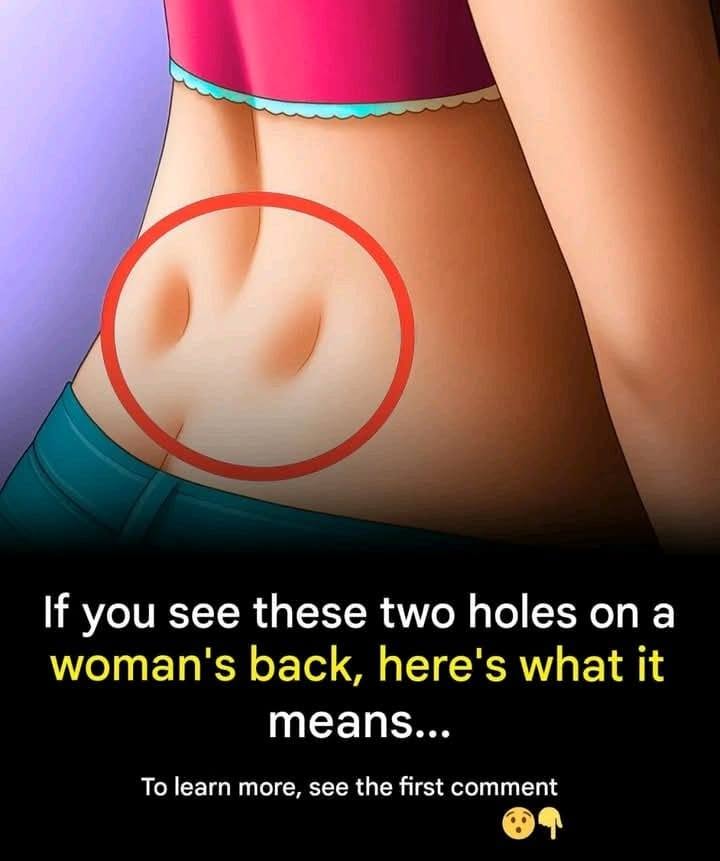
Have you ever noticed two small, symmetrical dimples just above the buttocks? They’re often called “Venus dimples” in women and “Apollo dimples” in men.
These small indentations are usually completely normal. They are mainly related to anatomy, genetics, and the way the skin attaches to structures around the pelvis.
But what do these dimples actually mean?
What Are the Two Dimples in the Lower Back?
The dimples are typically located on either side of the lower spine, around the area of the sacroiliac joints.
They can appear as small indentations where the skin is connected more closely to underlying connective tissue and structures around the pelvis.
Some people have clearly visible dimples, while others have very subtle ones or none at all.
Why Do Some People Have Them?
Genetics plays an important role.
The appearance of lower-back dimples can be influenced by:
- Bone and pelvic structure
- Distribution of body fat
- Skin and connective-tissue attachments
- Genetics
- Overall body composition
Because everyone’s anatomy is different, the dimples can vary considerably in size and visibility.
Are Venus Dimples a Sign of Good Health?
Not necessarily.
You may see claims online that these dimples indicate excellent circulation, good physical fitness, fertility, or a particularly healthy body.
There is no good scientific evidence that simply having lower-back dimples proves that a person is healthier than someone who doesn’t have them.
They are primarily an anatomical feature.
A person can be perfectly healthy without them, while someone with prominent dimples can have health conditions unrelated to their appearance.
Are Lower-Back Dimples Genetic?
Genetics appears to contribute to many aspects of body shape and anatomy, so the tendency to have visible dimples may run in families.
However, the exact appearance of these dimples isn’t determined by one simple “dimple gene.”
Factors such as body composition and the underlying shape of the pelvis can also influence how visible they are.
Do They Mean You’re Fit?
Not necessarily.
Lower-back dimples can be more noticeable in people with lower amounts of body fat because the underlying anatomical structures are easier to see.
This may explain why they’re sometimes associated with athletic or fit bodies.
But having visible dimples isn’t a measurement of fitness.
Someone can exercise regularly and not have them, while someone who doesn’t exercise much may naturally have prominent dimples.
Can Exercise Create Lower-Back Dimples?
Exercise can change muscle development and body composition, which may make existing anatomical features more visible.
However, you can’t reliably create these dimples through a specific exercise.
Exercises such as squats, lunges, deadlifts, and core-strengthening movements can improve overall strength and body composition, but they don’t specifically “carve” Venus dimples into the lower back.
Do Lower-Back Dimples Mean Anything About Personality?
You may encounter claims that people with Venus dimples are more attractive, energetic, lucky, confident, or sexually desirable.
These are cultural beliefs and internet myths, not established medical facts.
The appearance of two small dimples cannot reliably tell you anything about someone’s personality, character, intelligence, or relationships.
Are They Related to Back Problems?
Usually, no.
Simple, symmetrical dimples that have been present for a long time are generally just part of normal body anatomy.
However, a new or unusual indentation accompanied by pain, swelling, skin changes, weakness, numbness, or other symptoms should be assessed by a healthcare professional.
Some skin dimples present from birth can occasionally be associated with underlying spinal abnormalities, particularly when they have unusual features or are located directly over the midline of the spine. These are different from the typical paired dimples seen above the buttocks.
When Should You See a Doctor?
Most lower-back dimples don’t require medical attention.
Consider getting a medical evaluation if a dimple:
- Appears suddenly
- Becomes painful
- Develops redness or swelling
- Drains fluid or blood
- Is associated with a lump
- Occurs with numbness or weakness
- Is located directly over the spine and has unusual skin markings
- Is accompanied by significant or persistent back symptoms
These signs don’t automatically indicate a serious problem, but they deserve professional assessment.
The Bottom Line
The two small dimples above the buttocks are usually a normal anatomical feature influenced by genetics, pelvic structure, connective tissue, and body composition.
They’re sometimes called Venus dimples or Apollo dimples, but their appearance doesn’t provide a reliable measure of health, fitness, fertility, personality, or attractiveness.
So if you have them, there’s generally no special health meaning behind them—and if you don’t, there’s nothing wrong with you either.
They’re simply one of the many ways normal human bodies can look different.