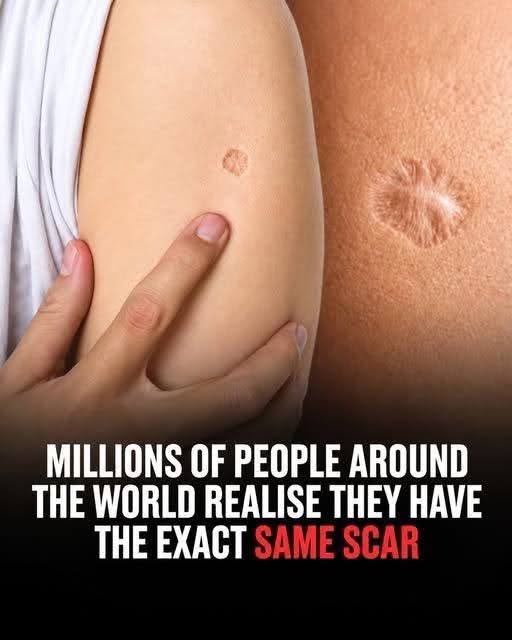
For millions of people, the answer may be surprisingly simple: a childhood vaccination.
The photograph above shows two examples of round scars on the upper arm. The appearance is strikingly similar, but it is important not to assume that every scar like this has exactly the same cause. Two common possibilities are BCG vaccination and, in older generations, smallpox vaccination.
Let’s take a closer look at the fascinating history behind these little scars.
The Mysterious Little Scar
A small circular scar on the upper arm can be something people carry for decades without remembering how they got it.
For many people who received BCG (Bacille Calmette-Guérin) vaccination, a small scar can remain at the injection site. BCG is a vaccine used to help protect against tuberculosis, particularly severe forms of TB in children.
The World Health Organization explains that BCG is normally given by an intradermal injection and commonly produces a local reaction that can eventually leave a scar.
The scar can therefore become a tiny reminder of a vaccination received during infancy or childhood.
Why Does a Vaccine Leave a Scar?
Most injections don’t leave a permanent mark.
BCG is different because it is administered into the skin rather than deep into the muscle. The vaccination can produce a local immune reaction.
The area may initially develop a small bump, followed by redness or a sore. As it heals, scar tissue can remain.
WHO material describes the typical BCG reaction as developing over weeks and eventually leaving a small scar.
That is why someone may look at their arm decades later and still see evidence of a vaccination they received as a baby.
Is Everyone With a BCG Scar Protected From TB?
This is an important point.
A visible BCG scar does not prove how well an individual is protected against tuberculosis.
WHO specifically notes that scar formation is not a reliable marker of protection, and some people who receive BCG do not develop a visible scar.
So the scar is better thought of as evidence of a local vaccination reaction—not a personal measurement of immunity.
Another Possibility: The Smallpox Vaccine
There’s another historic vaccination that can produce a very recognizable scar: smallpox vaccination.
People vaccinated against smallpox often developed a distinctive scar on the upper arm.
Unlike many modern vaccines, the traditional smallpox vaccine was designed to produce a visible local skin reaction. According to the CDC, the vaccination site could develop into a blister or pustule, followed by a scab that eventually fell away and commonly left a small scar.
This is why some older adults have a noticeable round or somewhat pitted scar on their arm.
Why Do the Scars Look So Similar?
Vaccinations are generally given at standardized anatomical locations.
BCG vaccination, for example, is deliberately administered at a consistent location on the upper arm so healthcare workers know where to look for the vaccination site.
The smallpox vaccination also commonly produced a scar in the upper-arm area.
When the same type of vaccine is administered in approximately the same location using a similar technique, it isn’t surprising that scars can have a similar appearance.
A Small Scar With a Big History
These scars tell an interesting story about public health.
Vaccination programs have reached enormous numbers of people around the world. A tiny mark on someone’s arm can therefore represent participation in a much larger public-health effort.
The smallpox story is particularly remarkable.
Smallpox was a devastating infectious disease, but worldwide vaccination efforts ultimately led to its eradication. The CDC notes that the last naturally occurring case was recorded in 1977.
Today, routine smallpox vaccination is no longer necessary for the general public because smallpox has been eradicated.
That means the characteristic smallpox vaccination scar is also becoming increasingly associated with older generations.
BCG and Smallpox Scars Are Not Necessarily the Same
This is where social-media posts can become misleading.
A photograph showing a circular upper-arm scar doesn’t allow us to determine with certainty which vaccine caused it.
Location, shape, size, and appearance can provide clues, but they aren’t enough to establish the cause in an individual person.
For example, BCG scars can vary depending on the vaccine strain, technique, and individual response. WHO notes that scar formation and appearance can vary, and not everyone develops a scar.
Other injuries or childhood vaccinations can also leave marks.
So, What’s the Scar in the Photograph?
The image itself cannot establish the medical history of the people pictured.
The small, round upper-arm scar shown is compatible with a vaccination scar, and depending on the person’s age and vaccination history, BCG or historic smallpox vaccination could be possibilities.
It’s therefore better to say that the photograph illustrates a common type of vaccination scar rather than claiming that every person with an identical-looking mark received the same vaccine.
Should You Be Worried About Your Scar?
If you’ve had the same small scar for many years and it hasn’t changed, it is generally simply an old scar.
A typical vaccination scar from childhood isn’t something that needs to be removed or treated.
However, a scar that is new, rapidly changing, painful, bleeding, ulcerated, or repeatedly becoming inflamed is different and should be examined by a healthcare professional.
Don’t try to remove an old vaccination scar with acids, home remedies, cutting, or other DIY methods.
The Little Mark We Often Ignore
It’s fascinating to think that something as ordinary as a tiny mark on the upper arm can have a connection to major events in medical history.
For one person, it may represent a childhood BCG vaccination.
For another, particularly someone vaccinated many decades ago, it may be a smallpox vaccination scar.
Either way, it can be a reminder of how vaccination programs have shaped public health across generations.
Final Thoughts
That little circular mark on your arm may look insignificant, but it can have an interesting story behind it.
Millions of people have vaccination scars, but not every similar-looking scar has the same origin.
If you have one, your vaccination records, age, country of childhood vaccination, and medical history are much more reliable than the appearance of the scar alone for determining what caused it.