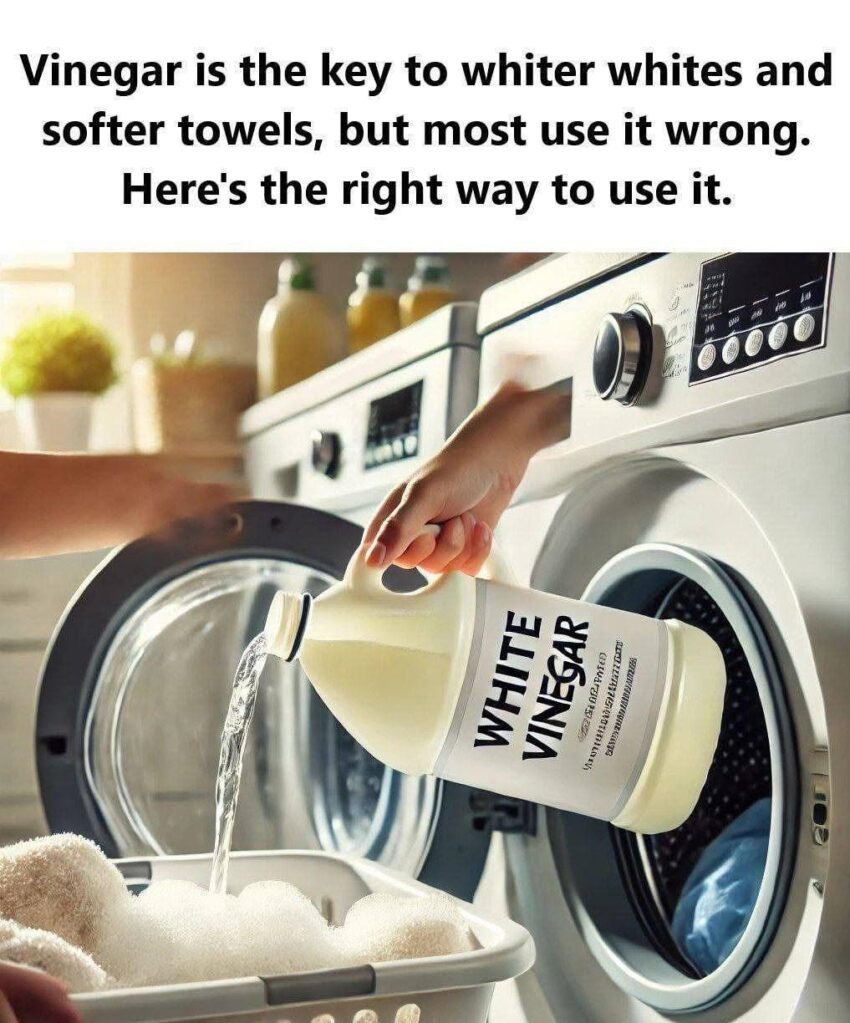
White vinegar is one of the most popular natural laundry tricks, especially for towels that feel stiff or clothes that have a lingering smell.
The biggest mistake is pouring vinegar directly into the washing machine together with your detergent. For most laundry, vinegar is better used during the rinse stage.
The Right Way to Use Vinegar in the Washing Machine
For Softer, Fresher Towels
Use plain distilled white vinegar, not flavored or cleaning vinegar.
Step 1: Add Your Detergent Normally
Put your normal laundry detergent in the detergent compartment.
Don’t replace your detergent with vinegar. Vinegar doesn’t contain the surfactants needed to properly remove body oils, dirt and grime.
Step 2: Put Vinegar in the Fabric-Softener Compartment
For a typical household load, you can use approximately:
½ cup (120 ml) distilled white vinegar
Place it in the fabric-softener dispenser if your machine’s manufacturer permits vinegar use.
The dispenser releases it during the rinse cycle, after most of the detergent has already done its job.
Step 3: Wash as Normal
Choose the appropriate cycle and water temperature for the towels or clothing.
When the rinse begins, the vinegar is diluted and can help remove leftover detergent and mineral residue.
Why Does Vinegar Make Towels Feel Softer?
Towels can become stiff when detergent, minerals from hard water and other residues accumulate in the fibers.
Vinegar’s acidity can help dissolve some mineral and detergent residue.
The result may be towels that feel less stiff and fresher.
However, vinegar doesn’t coat towels with a traditional fabric-softener film. That’s one reason some people prefer the feel of vinegar-treated towels.
What About Whiter Whites?
This is where viral laundry advice often exaggerates.
Vinegar does not bleach white clothing.
If your white towels have become gray or yellow, the more effective approach is usually:
- Use a good laundry detergent.
- Wash according to the care label.
- Use an appropriate oxygen-bleach product when suitable for the fabric.
- Use vinegar separately in the rinse if desired.
For stubborn stains, pretreatment is often more effective than simply adding more vinegar.
A Simple Routine for White Towels
For washable white cotton towels:
Wash:
Laundry detergent + appropriate wash cycle
For whitening:
Use oxygen bleach according to its label, if the towel’s care instructions allow it.
For the rinse:
Use distilled white vinegar in the fabric-softener dispenser if your washing-machine manufacturer allows it.
Dry:
Dry completely according to the care label.
This separates the cleaning, whitening and rinsing jobs instead of expecting one ingredient to do everything.
The Most Important Rule: Never Mix Vinegar With Chlorine Bleach
This is extremely important.
Never combine vinegar with chlorine bleach.
Mixing an acid such as vinegar with chlorine bleach can release dangerous chlorine gas.
If you’re using chlorine bleach, follow the bleach and washing-machine instructions and keep vinegar out of the same wash.
Don’t Pour Vinegar Directly Onto Clothes
It’s better to use the washing machine’s dispenser when available.
Adding concentrated vinegar directly onto fabrics isn’t necessary and gives you less control over when it enters the wash.
The dispenser is designed to release liquid during the appropriate stage.
Don’t Use Vinegar With Every Fabric
Vinegar isn’t appropriate for every textile or appliance.
Be particularly cautious with:
- Elastic-containing garments
- Delicate fabrics
- Some technical or performance fabrics
- Clothing with special finishes
- Items with manufacturer instructions against acidic products
Always follow the garment-care label.
What About the Washing Machine Itself?
Some people recommend routinely running large amounts of vinegar through a washing machine to clean it.
That’s not necessarily the best approach.
Some washing-machine manufacturers advise against vinegar or other acidic products because repeated exposure may affect rubber components, seals or other parts.
Check your machine’s manufacturer’s instructions before making vinegar a regular part of your laundry routine.
If the manufacturer doesn’t recommend it, use the machine’s designated cleaning cycle and approved washing-machine cleaner instead.
Can You Use Vinegar With Fabric Softener?
Usually, you don’t need both.
Vinegar is being used as an alternative rinse additive, not something that needs to be combined with conventional fabric softener.
For towels in particular, excessive fabric softener can reduce absorbency because it can leave a coating on the fibers.
The Best Amount Isn’t “More Is Better”
Adding a large amount of vinegar won’t necessarily make laundry cleaner or softer.
Start with a moderate amount—around ½ cup for a typical full load—if your machine manufacturer permits it.
For smaller loads, less may be appropriate.
The Bottom Line
Vinegar can be useful in laundry, but it isn’t a miracle whitening agent.
The right way is:
Detergent in the detergent compartment → wash normally → vinegar in the fabric-softener dispenser during the rinse stage.
For truly yellowed or dingy whites, use a suitable oxygen-bleach product according to its instructions rather than relying on vinegar alone.
And remember the most important safety rule:
Never mix vinegar with chlorine bleach.
Used appropriately, vinegar can help reduce residue and odors and may leave towels feeling fresher and less stiff—but good detergent, correct washing, proper drying and appropriate stain treatment do most of the real cleaning.