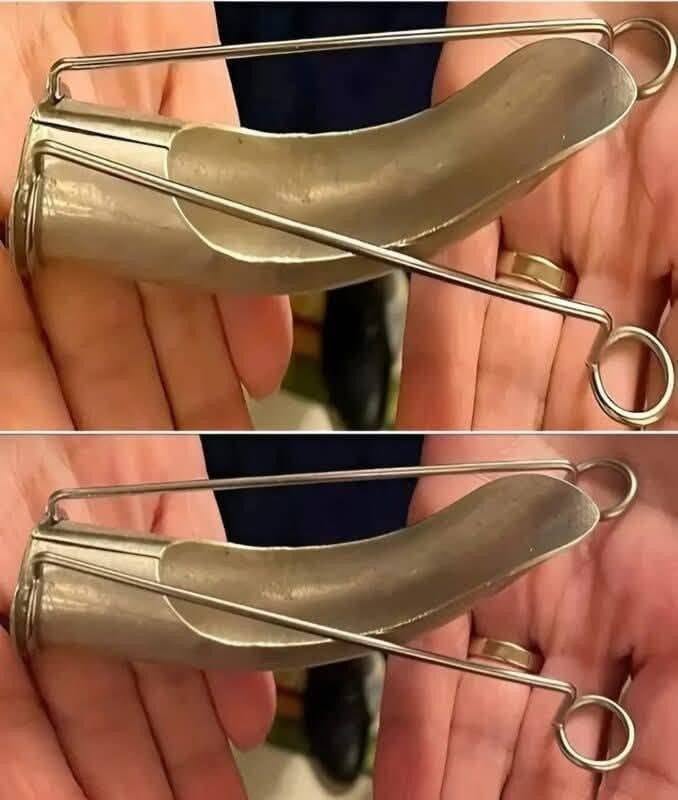
At first glance, the unusual metal device shown in the photograph can easily leave people wondering what it is and why someone would keep one in a drawer. Its curved metal plate, long wire-like arms, and circular loops make it look quite different from the medical instruments we see today.
However, the design gives us an important clue.
The object in the photograph appears to match a historical medical instrument known as a Ward Cousin’s tongue depressor. The Science Museum Group has a documented example of this instrument dating from approximately 1870–1910, made of metal and classified as a tongue depressor used in clinical diagnosis.
So, despite its unusual appearance, this old-fashioned device was associated with medical examination of the mouth and throat, rather than being a household gadget or a modern personal device.
What Is the Device?
The instrument is generally identified as a Ward Cousin’s tongue depressor.
The Science Museum Group’s collection contains an example listed as:
- Name: Ward Cousin’s Tongue Depressor
- Period: 1870–1910
- Country: United Kingdom
- Material: Metal alloy
- Length: Approximately 130 mm
- Width: Approximately 35 mm
- Category: Clinical Diagnosis
- Object number: A647297
Historical medical instruments often look strange to modern eyes because doctors used mechanical designs that are no longer common today.
The pictured instrument has a broad, curved metal portion that is the most recognizable feature. Its shape was designed to interact with the tongue during examination.
What Was a Tongue Depressor Used For?
A tongue depressor is a medical instrument used to hold or press the tongue down so that a doctor can see deeper into the mouth and throat.
This can make it easier to examine areas such as the back of the mouth and throat.
Today, most people are familiar with the simple wooden tongue depressor used during a throat examination. Older medical instruments, however, could be considerably more elaborate.
Instead of simply holding a flat wooden stick, historical doctors sometimes used specially designed metal instruments with mechanical components.
Why Does This One Look So Complicated?
The unusual appearance is one of the most interesting things about this instrument.
Modern tongue depressors are generally extremely simple. A disposable wooden stick can accomplish the basic task without complicated mechanisms.
Older instruments were often made from durable metals and designed to be reused. The Ward Cousin’s design was one of several historical approaches to tongue depression.
A nineteenth-century surgical-instrument catalogue from Evans & Wormull specifically lists “Ward Cousins’ Tongue Depressor” alongside other tongue depressors and tongue-holding instruments.
This provides additional historical evidence that the instrument was part of the medical equipment used during that period.
Why Does It Have Rings?
The circular rings are another feature that can make the device look mysterious.
The rings and wire framework formed part of the instrument’s operating mechanism and provided a way for the user to manipulate the device.
This is quite different from a modern disposable tongue depressor, which simply consists of a flat piece of wood.
Historical medical instruments frequently used handles, loops, hinges, springs, and other mechanical features to allow a doctor to control an instrument precisely.
Was It a Surgical Instrument?
It is better described as a medical diagnostic instrument rather than assuming that it was used for major surgery.
The Science Museum Group categorizes its documented Ward Cousin’s example under Clinical Diagnosis and identifies the object type specifically as a tongue depressor.
That distinction is important because many old medical instruments can look intimidating even when their purpose was simply examination.
When Was It Used?
The Science Museum Group dates its example to 1870–1910, placing it in the late nineteenth and early twentieth centuries.
This was a period when medical instruments were increasingly specialized.
Doctors and instrument makers developed different tools for examining specific parts of the body. Metal instruments were particularly useful because they could be cleaned and reused, unlike many disposable medical products used today.
The Science Museum Group’s collection contains numerous historical tongue depressors from different periods and materials, demonstrating that this type of instrument existed in many forms.
Why Would Someone Have One in a Drawer?
Finding an old medical instrument in a home can obviously raise questions.
There are several perfectly ordinary possibilities.
Someone may have:
- inherited it from an older family member;
- purchased it as an antique;
- kept it as a curiosity;
- collected old medical instruments;
- acquired it from an old medical practice or estate;
- simply kept it because they did not know exactly what it was.
Therefore, the presence of the instrument by itself does not tell us who used it, when it was used, or why it was kept.
That is an important distinction when trying to identify objects found in an old drawer, box, or cabinet.
Is It a Personal or Intimate Device?
Because the instrument looks unusual, people may make assumptions about its purpose when they first see it.
However, the documented historical examples provide a much more straightforward explanation.
The Science Museum Group explicitly identifies a very similar instrument as Ward Cousin’s tongue depressor, a historical medical instrument.
That means there is no need to assume that an unusual-looking object must have been designed for an intimate or sexual purpose simply because its function is not immediately obvious.
Of course, a photograph alone cannot establish the complete history of a particular physical object. The exact item in the photograph could be a reproduction, another historical tongue depressor, or a closely related instrument. But its design is strongly consistent with this category of old medical instrument.
How Can You Identify an Old Medical Instrument?
If you discover an unfamiliar metal instrument, look for several clues.
1. Examine the shape
The shape of the working end often tells you what part of the body or what type of procedure the instrument was designed for.
2. Look for finger rings
Finger rings are common on many medical instruments because they allow the practitioner to control the instrument.
3. Check for hinges or moving parts
Mechanical components can indicate that the instrument was designed to open, close, press, hold, or manipulate something.
4. Look for markings
Manufacturers sometimes stamped their names, locations, patent numbers, or model information onto medical instruments.
Even a small engraving can make identification much easier.
5. Compare it with museum collections
Historical collections are particularly useful because museums preserve photographs, measurements, dates, materials, and descriptions of old medical instruments.
For example, the Science Museum Group documents several different historical tongue depressors, including Ward Cousin’s design.
The Fascinating History of Medical Instruments
One reason objects like this attract so much attention is that medical equipment has changed dramatically over the last century.
A tool that looks strange today may have been a perfectly recognizable piece of equipment to a doctor in the 1800s.
The development of medical instruments also reflects changes in medical practice. As doctors learned more about anatomy and diagnosis, specialized instruments were developed to help them examine particular areas of the body.
The Ward Cousin’s tongue depressor is one example of that history.
The Science Museum Group preserves such instruments as part of the history of clinical diagnosis and medical technology.
Final Thoughts
The mysterious metal device in the photograph is very likely a historical tongue-depressor-type medical instrument, with its design closely matching the documented Ward Cousin’s tongue depressor.
A Science Museum Group example is dated to approximately 1870–1910 and is officially catalogued as a metal tongue depressor used for clinical diagnosis. Historical surgical-instrument catalogues also list Ward Cousins’ tongue depressor among medical instruments of the period.
What looks strange or even mysterious today may simply be an example of how differently medical equipment was designed in the past.
Important note: The exact identity of an object should ideally be confirmed by comparing its dimensions, markings, construction, and provenance with a museum or specialist catalogue. The photograph alone cannot establish the personal history of the particular item shown.
Frequently Asked Questions
What is this old-fashioned metal device?
It appears to be a historical tongue depressor, closely resembling the Ward Cousin’s tongue depressor documented by the Science Museum Group.
What was a tongue depressor used for?
It was used by medical practitioners to hold the tongue down during examination of the mouth and throat.
How old is this type of instrument?
A documented Ward Cousin’s tongue depressor in the Science Museum Group collection dates from approximately 1870–1910.
Is it a modern medical device?
No. The example documented by the Science Museum Group is a historical medical instrument.
Could this exact object be something else?
Possibly. A photograph cannot prove the exact model or history of an individual object. The strongest identification should come from comparing the physical object with documented museum examples.
Why does it have metal loops and a curved plate?
Those features are part of the mechanical design of the historical instrument and allowed the practitioner to manipulate the device while examining the tongue and mouth.
Was it designed as a household item?
The documented Ward Cousin’s example is classified as a clinical diagnostic instrument, not a household tool.
Suggested SEO keywords:
old fashioned metal device, what is this metal device, antique medical instrument, vintage medical instrument, Ward Cousin tongue depressor, old tongue depressor, mysterious metal tool, historical medical tools, antique medical equipment, old medical instruments
Meta description:
What is this strange old-fashioned metal device? Discover the history of the Ward Cousin’s tongue depressor, how it was used, and why this unusual medical instrument looks so mysterious today.